The maintenance question nobody covers in a buying guide
Our tennis racquet buying guide and badminton racket buying guide both end at the same point: string tension and material are the final tuning layer, and — unlike head size or weight — they're cheap to change without buying a new racket. What neither guide covers is what happens after you own the racket: how do you know it's time to restring, should you learn to do it yourself, and what do you actually need to tell a stringer if you don't?
That's this piece. It applies to both sports because the underlying logic — when strings degrade, what DIY costs you in time versus money, how to communicate a restring order — is genuinely shared. Where tennis and badminton diverge (and they diverge a lot on one specific point: how often the strings actually break), we'll call it out explicitly rather than pretend the two sports are identical.
Signs it's time to restring
The obvious one: a broken string. A snapped string ends the conversation — you're restringing, full stop. But broken strings are the easy case. The harder, more common case is a racket that's still technically strung but has quietly stopped performing the way it did when it was new.
String movement that won't reset. Strings are supposed to snap back into their original grid position after you push them aside between points. As strings age, the friction at the crossing points wears down, and they stop resetting — you'll find yourself manually straightening the string bed between every point, or notice one point where two strings sit crossed at an odd angle no matter how many times you push them back. That's a sign the strings have lost enough elasticity that they're no longer behaving as a unit, even if none have actually snapped.
A "dead" or muted feel. Strings — natural gut and multifilament nylon especially — lose tension gradually just sitting in the racket, independent of how much you play, through simple material creep and exposure to temperature and humidity. A string bed that's lost tension feels softer and less lively off the strings even on a clean hit, and shots that used to have some pace on them start landing shorter than you're swinging for. If you can't point to a specific broken string or visible fraying but the racket just feels flat compared to when it was freshly strung, tension loss is the likely culprit.
Visible fraying or notching. Look closely at the points where main and cross strings intersect — that's where the most friction happens on every hit. Fuzzy, frayed, or visibly grooved/notched string material at those crossing points is a sign the string is close to failing even if it hasn't yet, and it's a stronger signal than time elapsed alone.
Playing frequency, as a rule of thumb. The most commonly cited guideline in both racket-stringing communities is to restring as many times a year as you play per week — play twice a week, restring roughly twice a year; play daily, restring far more often than that. We checked this rule of thumb against several tennis-stringing and racquet-shop sources before including it here, and it holds up as a genuinely common, long-standing recommendation — but it comes with real caveats worth stating alongside it. It was built around casual, once- or twice-a-week recreational play, and multiple stringers now argue it undershoots how often serious or frequent players should restring, with some recommending double that pace for competitive players. Treat it as a floor, not a ceiling, and let the actual condition of the strings (feel, movement, fraying) override the calendar-based rule whenever the two disagree.
Tennis vs. badminton: a real difference in how often you'll do this
This is the one place the two sports genuinely diverge, and it's worth being upfront about it: badminton strings break far more often than tennis strings, for two compounding reasons.
Tension. Tennis racquets are typically strung somewhere in the low-50s to high-60s (in pounds), relative to a frame designed to handle that load comfortably. Badminton racquets are strung lower in absolute terms — commonly in the high-teens to low-30s — but that number sits much closer to the frame's actual rated maximum, meaning badminton string beds routinely operate near the top of what the frame and string can handle rather than comfortably below it.
String gauge. Badminton strings are also considerably thinner than tennis strings — commonly around 0.65–0.70mm in diameter, compared to tennis strings that are meaningfully thicker. Thinner string cuts through the shuttle's feathers or synthetic skirt cleanly for better feel and repulsion, but it also has less material to absorb repeated impact before failing, especially on an off-center or mis-hit shot.
Put those two together and a competitive or even moderately frequent badminton player can expect to break strings on a timescale of weeks, not months — sometimes multiple times in a single intensive session. That reality shapes the DIY-versus-pro decision below more than almost anything else in this piece: the math on owning a stringing machine looks completely different for a badminton player restringing every few weeks than for a once-a-week tennis player restringing twice a year.
DIY stringing: what it actually takes
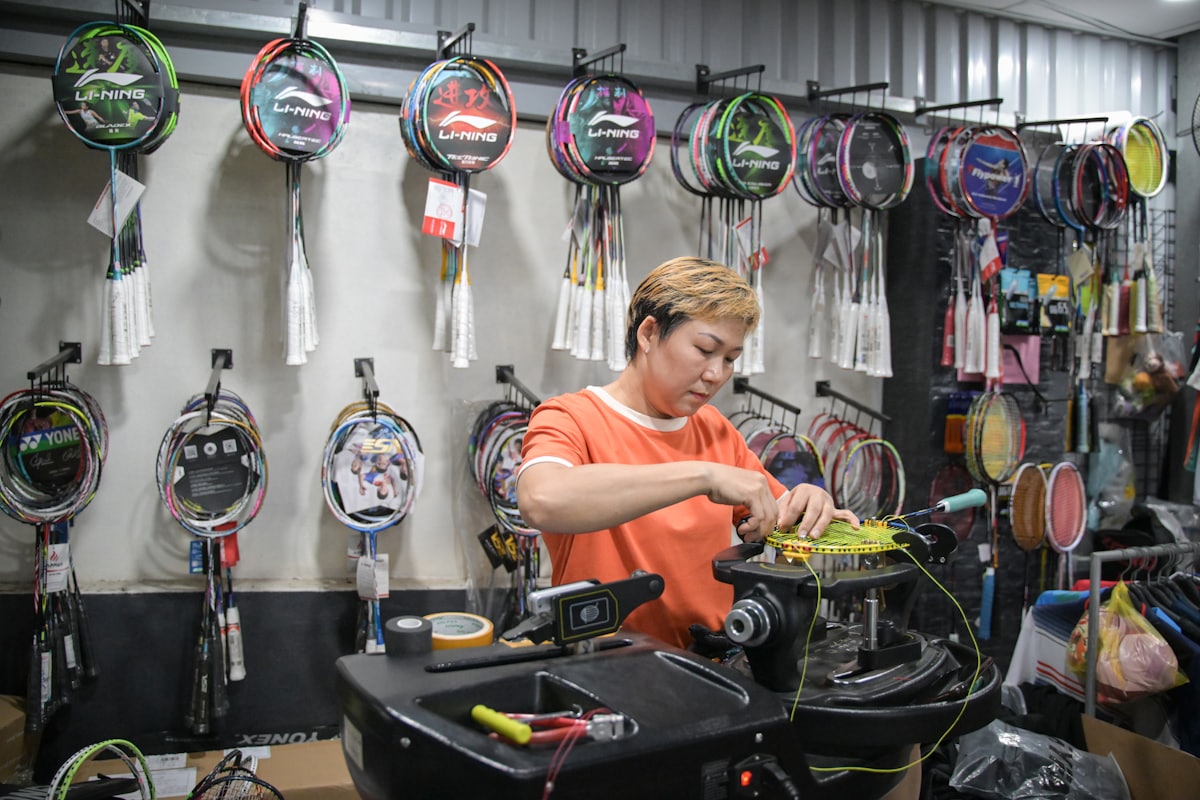
The machine. A stringing machine — even an entry-level drop-weight or crank model — is the real barrier to DIY, both in cost and in the counter-space it demands. Drop-weight machines are the cheapest and most forgiving to learn on, since the weight itself enforces a consistent tension rather than relying on your own feel; electronic constant-pull machines cost considerably more but hold tension more precisely and are faster once you know what you're doing.
The learning curve. Stringing a racket well is a genuine skill — threading the pattern correctly, maintaining even tension across the bed, tying off clean knots, and not damaging the frame's grommets in the process. Your first several restrings will likely be slower and less consistent than a shop job, and a poorly executed job (uneven tension, a slipped knot) can undo the entire point of restringing in the first place. Expect a real learning period, not a one-video shortcut.
When DIY makes sense. The economics tip toward DIY the more often you restring, because the machine is a fixed cost you're spreading across more restrings. That's exactly why DIY shows up disproportionately among frequent badminton players — someone breaking strings every few weeks is restringing often enough that a machine pays for itself in saved shop fees within a season or two, and being able to restring the same night a string breaks (rather than waiting on a shop's turnaround) has real practical value when you can't get to a court without a strung racket. A once- or twice-a-year tennis player, by contrast, is very unlikely to recoup a machine's cost, no matter how satisfying it might be to own one.
When it doesn't. If you restring only a couple of times a year, the math heavily favors paying a shop: a machine and the accessory tools (a starting clamp, awl, pliers) cost meaningfully more than years of shop restrings at that frequency, and the skill only stays sharp with regular practice — infrequent use means relearning technique each time, which raises the odds of a bad job on the racket you actually need to play with.
Pro stringing: what to communicate to a stringer
If you're not stringing your own racket, the value you get from a shop depends heavily on how precisely you can describe what you want — a stringer can execute exactly what you ask for, but can't read your mind about preferences you haven't stated.
Tension, as a specific number. Don't just say "medium" — give an actual number (or a tight range) within your frame's rated tension window, which is typically printed on the frame near the throat. If you don't know your number yet, tell the stringer your experience level and what you're optimizing for (more power and comfort, or more control), and reference the tension-and-feel tradeoff from the buying guides: lower tension in your frame's range trades control for more power and a softer, more forgiving feel, while higher tension trades some power and comfort for a firmer, more precise response.
String type/material, not just "whatever you usually use." A shop's house default is a reasonable string, but it may not match what you actually want — see the material section below.
Which strings for mains versus crosses, if you're hybridizing. Some players intentionally string different materials for the main (vertical) and cross (horizontal) strings — for example, a durable polyester main paired with a softer, more comfortable cross in tennis — to blend durability and feel. If you don't have a specific hybrid setup in mind, a single material strung throughout is the simpler, and for most recreational players entirely sufficient, default.
Any pattern or gauge preference, if you have one — thicker gauge strings generally last longer but feel and play slightly differently than thin gauge, which is a real consideration for a badminton player weighing string life against feel.
Communicate all of that clearly and a shop restring is genuinely comparable in quality to a well-executed DIY job — the convenience and consistency of an experienced stringer using a well-maintained machine is real, and for players who restring infrequently, that convenience is usually worth more than the money saved doing it yourself.
String material basics
Tennis: synthetic gut, natural gut, and polyester. Synthetic gut is the affordable, all-purpose default — a sensible choice if you don't yet have strong material preferences. Natural gut (made from cow intestine, not a synthetic substitute) delivers the best feel and comfort of any tennis string but is also the most expensive and least durable against abrasion, which is why it shows up mostly on advanced players' racquets rather than as a default restring choice. Polyester ("poly") strings are stiff and durable, favored by hard-swinging players who want control and spin without the string bed deforming, but that stiffness transmits more shock to the arm and generally isn't the right first choice for a developing or recreational swing.
Badminton: nylon multifilament as the default. The overwhelming majority of badminton stringing — recreational through club-competitive — uses nylon multifilament string, which balances repulsion (power), feel, and reasonable durability at a sensible cost. Thinner gauges within that nylon category trade some durability for a livelier, more responsive feel; thicker gauges last longer under the frequent breakage badminton is prone to, at some cost to feel. Unless you have a specific reason to deviate, nylon multifilament in a mid gauge is the reasonable default for most players, with gauge as the lever to adjust toward feel or durability as your preference and break frequency dictate.
How tension choice connects back to the buying guide
If you read either buying guide, this will sound familiar, because it's the same tradeoff applied after purchase instead of before it: lower tension lets the strings flex and rebound more on contact, adding power and a softer, more forgiving feel at some cost to precision, while higher tension stiffens the response, trading some power and comfort for sharper control and more direct feedback.
The genuinely useful thing to understand is that tension is the cheapest, fastest way to retune a racket you already own and like. If a racquet or racket feels like it's lacking pop compared to when you bought it, you don't necessarily need a new frame — restringing at a couple of pounds lower than your last string job is a low-cost way to test whether more power solves the problem before you assume you need different equipment entirely. The same logic runs in reverse: if you feel like you've outgrown the forgiving, lower-tension setup you started on and want more precision now that your contact is more consistent, nudging tension up a notch or two at your next restring is a smaller, cheaper step than buying a new racket, and it's exactly the kind of "re-evaluate every year or two" adjustment both buying guides point toward as your game develops.
Sources
- United States Racquet Stringers Association (USRSA) — official site
- International Tennis Federation (ITF) — official site
- USTA — official site
- Badminton World Federation — Equipment Approval Scheme
- Badminton World Federation — Statutes
Now go use the freshly strung racket
A restring doesn't do much good without somewhere to test it. Find tennis courts near you or find badminton courts near you in The Court Scout's verified directory — every listing checked against a primary source rather than scraped from someone else's guesswork. If you're still working out the fundamentals before you worry about string tension, our buying guides for tennis racquets and badminton rackets are the place to start.