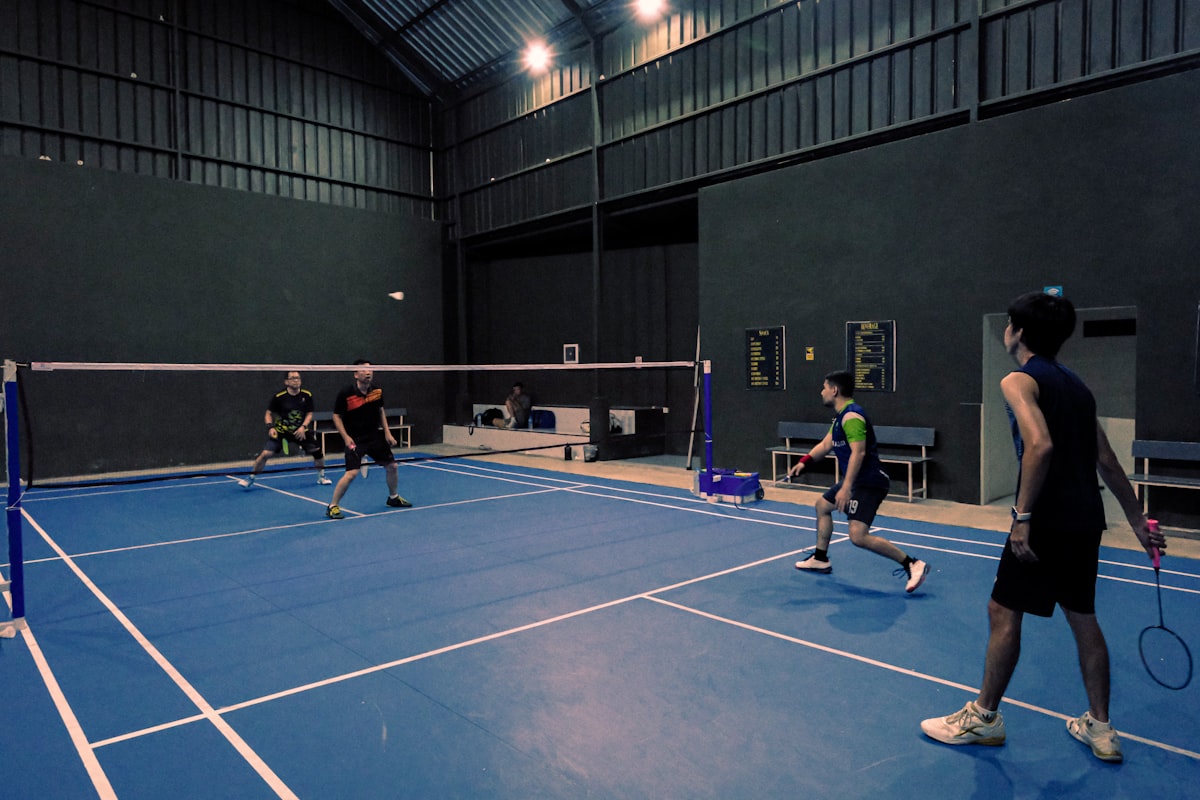
Two players, one court, and a formation decision on every rally
Watch a badminton doubles rally at any real speed and the first thing that jumps out isn't the shuttle — it's how often the two players on each side swap positions. One moment they're stacked front-to-back, one player crouched at the net and the other camped near the baseline. A few shots later they're standing shoulder to shoulder, side by side, mirroring each other's movement like they're tied together. That's not indecision. It's the entire tactical structure of doubles badminton, and understanding it is the difference between doubles feeling like organized chaos and doubles feeling like a system you and your partner can actually run on purpose.
Our scoring and match-format guide already covers how doubles and singles use different court boundaries — a wider but shallower service box for doubles, a narrower but deeper one for singles, both squeezed inside the same overall court. This guide builds on that and goes somewhere the scoring rules don't: what you and your partner actually do once the shuttle is live. Two formations, a rotation rule that governs how you move between them, the communication that keeps two people from colliding or leaving the same gap open, and — because it's the thing every singles player notices immediately when they first play doubles — why the whole sport speeds up and collapses toward the net once a second player is added to each side.
Formation one: front-and-back, for attacking
When your side is hitting downward on the shuttle — a smash, a steep drop, anything that's putting your opponents on the back foot — the standard formation is front-and-back: one partner plays close to the net, the other plays deep, roughly along the back third of the court.
The division of labor is straightforward once you see it:
- The back player is the primary attacker. They're the one hitting smashes, steep drops, and clears from the rear court, and they need the room behind them to generate real pace on those shots.
- The front player is the finisher. Their job is to sit near the net, racket up, watching for any weak, short reply your smash or drop forces out of the opponents — a shuttle that pops up even slightly gets killed at the net rather than given back to the opponents to reset the rally.
The logic behind front-and-back is about not wasting an advantage. If your side has forced the opponents into a defensive lift, that lift is a weakness — it's coming up high and, usually, short. A player standing at the net is already in position to punish it immediately with a kill or a tight net shot, instead of sprinting in from deep court and arriving too late. Coaching resources describe the core doubles principle bluntly: keep making the choices that preserve your side's chance to keep hitting downward, because that's what lets front-and-back formation stay intact.
Formation two: side-by-side, for defending
The moment your side is forced to hit the shuttle upward — you're defending a smash, returning a fast drive, or otherwise stuck lifting the shuttle back over the net rather than attacking it — the formation flips to side-by-side: both partners standing roughly level with each other, each covering one half of the court's width, left and right rather than front and back.
Side-by-side exists to solve a specific defensive problem: when you're lifting the shuttle, you don't control where the ensuing smash is going to land, and a fast smash can be directed anywhere across the doubles court's full width. Two players standing front-and-back can't cover that width — the back player would have to guess left or right and can't reach both. Two players standing side by side, though, split the court's width down the middle, and each partner has a manageable, roughly equal-sized zone to defend with a full swing available. It's a coverage decision, not a passivity decision: side-by-side isn't "giving up," it's the shape that gives your side the best chance of getting a racket on the return shot, wherever it's aimed.
The rule that governs switching between them: follow the shuttle
Neither formation is static, and good doubles players don't consciously think "now we're in front-and-back" or "now we're side-by-side" mid-rally — the switch happens automatically if you follow one governing principle: the formation you're in depends entirely on whether your side just hit the shuttle up or down, and it can flip on every single shot.
The practical version coaches teach: if you hit the shuttle downward (a smash or a steep attacking drop), your side should already be moving toward — or should already be in — front-and-back, because you're pressing an advantage. If you're forced to hit the shuttle upward (a defensive lift, a rushed return of a smash), your side should be moving toward side-by-side, because you're now the team at risk of being smashed and need full-width coverage.
Individually, this produces a specific, learnable habit: whoever plays a shot follows it. If you're the back player and you hit a drop shot into the front court, you don't stay put — you move forward behind your own shot, becoming the new front player, while your partner rotates back to cover the rear court you just vacated. If you're the front player and you're forced to lift a low, tight shot back deep, you don't stay at the net — you and your partner reset into side-by-side because that lift just handed the attack to the other side. This is why doubles rallies look like constant, fluid rotation rather than two fixed positions: the two formations aren't destinations, they're a live readout of who currently has the attack, updated shot by shot.
Communication: the part that actually makes rotation work
None of the above works if two players are guessing independently about who's covering what, and this is where doubles genuinely diverges from singles as a discipline — it's a two-person coordination problem, not just a positioning one. A few habits separate teams that rotate cleanly from teams that either collide or leave gaps:
- Call the shot before or as you take it. A short, immediate call — "mine," "got it," "yours" — resolves the split-second ambiguity that happens any time a shuttle lands in the seam between two players' zones, particularly straight down the middle of the court in side-by-side formation. Waiting to see if your partner moves first is how two players both leave a mid-court shuttle untouched.
- Call direction on your own attacking shots, especially cross-court smashes or drives, so your partner knows which way to shift their own coverage rather than assuming you hit it straight.
- Set expectations before the serve, not during the rally. Which partner is taking the net role to start the point, and which service-box responsibilities each of you has, are worth a quick word between points — it's much easier to agree on a plan in the two seconds before serving than to sort it out mid-rally under time pressure.
- Treat silence as a gap, not a plan. If nobody calls a shot in the moment it needs to be taken, the honest fix is more talking, not better guessing — doubles partners who trust their court sense but skip the verbal call are the pairs who eventually run into each other going for the same shuttle.
None of this needs to be loud, constant chatter through an entire match — it needs to be reliable at exactly the moments rotation is ambiguous: transitions between formations, and anything landing in the middle of the court.
Why doubles feels faster and closer to the net than singles
If you've played singles and then step into a doubles game, the pace change is immediate and it isn't your imagination. A few structural reasons doubles plays faster and tighter to the net than singles does:
There's less open court to exploit, so points are decided closer to the net. In singles, a player covers the entire court alone, which rewards long, high, deep shots — clears to the back corners, drop shots that make a lone opponent run — because there's real space to expose. In doubles, two players covering the same width means there's much less open court to hit into, so rallies compress toward the net and midcourt, where kills, tight net shots, and fast drives decide points rather than deep-court placement.
Net play is far less forgiving in doubles. A loose net shot in singles is often survivable, because there usually isn't an opponent standing right there ready to pounce on it — a lone singles opponent has the rest of the court to worry about too. In doubles, there's almost always a front player from the other side sitting at the net specifically hunting that kind of loose, floating reply. Net shots in doubles have to be tighter, flatter, and more precise, because a shot that sits up even slightly gets punished immediately.
Drives and flat exchanges dominate midcourt in a way singles rarely sees. Because both doubles teams often have a player at or near the net, a large share of doubles points get decided in fast, flat, low-to-the-net exchanges — hard, driven shots traded back and forth at pace, rather than the higher, slower, more deliberate rallying that characterizes singles. This is the exchange type that makes doubles rallies feel like a different speed entirely, and why reaction time and reflexes at the net matter as much as raw shot-making.
Points get finished rather than constructed. Singles strategy is often about patiently building an opening over several shots — moving an opponent side to side and front to back until a genuine gap appears. Doubles strategy, because of the front-and-back attacking formation, is built to convert an opening the instant it appears via a kill at the net, rather than stringing together a longer sequence of shots. That difference in intent — construct the point vs. finish it immediately — is a big part of why doubles rallies tend to run shorter and faster even with twice as many players covering the same court.
None of this makes doubles a lesser tactical game — the formation-switching and communication demands add a coordination layer singles doesn't have at all. It's simply a different sport wearing the same court lines, the same way our scoring guide shows singles and doubles quietly using two different service boxes inside one set of painted lines.
A short glossary
- Front-and-back formation — the attacking setup: one partner at the net hunting kills, the other deep hitting smashes and drops.
- Side-by-side formation — the defensive setup: partners split the court's width evenly to cover a smash that could land anywhere.
- Rotation — the continuous movement between formations, governed by who last hit the shuttle up versus down.
- Follow the shuttle — the habit of moving to cover the space your own shot just vacated (e.g., following a drop shot forward to the net).
- Net kill — a hard, downward shot played at the net to finish a rally against a weak, floating reply.
- Drive — a fast, flat shot hit at net height, common in doubles midcourt exchanges, that can be played offensively or defensively.
Where to go next
Formations and rotation are the tactical skeleton of doubles; the racket in your hand shapes how well you can actually execute a fast net kill or a controlled defensive drive. Our badminton racket buying guide walks through weight, balance, and string tension — including how singles vs. doubles play should influence the racket profile you choose — without pushing a specific brand. And if you haven't already, the scoring and match-format guide covers the rally-point scoring system and the singles/doubles service-box difference that everything in this guide assumes you already know. For how to actually hit the net shot, tumble, kill and lift this guide keeps referring to — plus the two net faults that cost doubles players points — see our badminton net play technique guide.
Sources
This guide is grounded in badminton's core attacking/defending doubles-formation principle as taught across established coaching resources, and cross-checked for consistency across multiple independent sources rather than relying on a single writer's framing:
- Badminton Bible — Doubles Tactics
- Badminton Bible — Doubles Positions (front-and-back vs. side-by-side)
- BadmintonSkills — Badminton Doubles Tactics: Positioning, Rotation and Communication Explained
- Badminton World Federation — Laws of Badminton (Statutes Section 4.1, PDF) — court and service-box dimensions referenced from our scoring guide
Ready to put this into practice? The Court Scout maintains a verified directory of badminton courts across the US — every venue confirmed against a primary source, with real Google ratings where available. Find courts near you and get your doubles rotation on the court instead of the page.