Why this is a different question than "what are the rules"
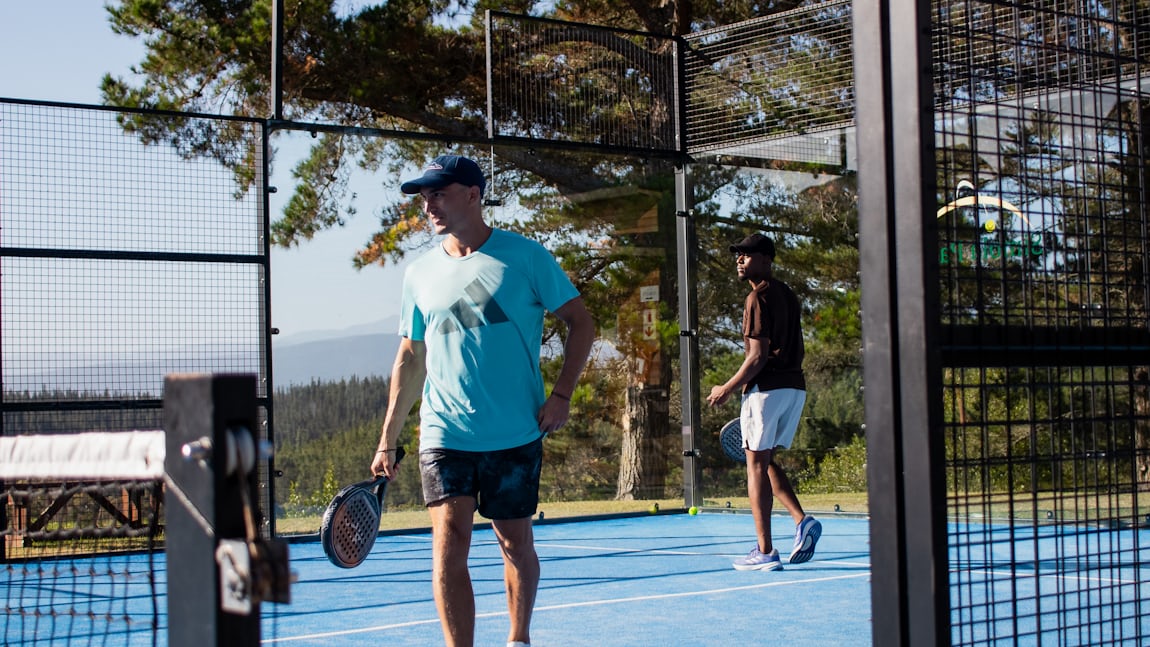
If you've read our guide to padel's playing rules, you already know the basic shape of a court: a 20-by-10-meter enclosure with glass at the ends, mesh fencing filling out the rest, and a low net. That's the player's-eye view, and it's enough to understand a match. It is not enough to sign a construction contract.
If you're a club operator, an HOA board evaluating an amenity, or an investor pricing out a padel build, "meets FIP standards" is a phrase you'll hear from every contractor and glass supplier who wants your business — and it means different things depending on who's saying it. Some of that language is precise and verifiable. Some of it is marketing shorthand stretched well past what the International Padel Federation (FIP) actually requires or endorses. This guide works from FIP's own Rules of Padel — the same primary document we used to fact-check our player-facing rules piece — plus the public materials from FIP's own official court and turf suppliers, to separate the two.
Two things up front, because they matter for how you read a contractor's pitch. First, FIP's public rulebook defines a detailed construction envelope — dimensions, wall structure, mesh, surface, access, and safety-zone rules — that any competent builder can meet without FIP's involvement at all. Second, FIP does not appear to publish a general "any facility can apply for a court certificate" homologation process; the certification language you'll see in the market mostly traces back to specific manufacturer partnerships, which is a materially different thing. Both points are covered in detail below.
Court dimensions and tolerances
Per FIP's rulebook, the playing area is a rectangle measured on the inside of the enclosure: 10 meters wide by 20 meters long, with a 0.5% tolerance — meaning the built dimensions can vary by up to roughly 5 cm on the 10 m width and 10 cm on the 20 m length and still be compliant. The two halves of the court, split by the net, must be perfectly symmetrical, and all court lines must be 5 cm wide, in white or black for contrast against the floor.
Ceiling height is where a lot of budget builds get squeezed, and it's worth planning around rather than treating as an afterthought. FIP sets a hard minimum of 6 meters of clear height throughout the court, with no obstructions — light fixtures included — inside that zone. For new construction, FIP's own text goes further: it recommends a minimum of 8 meters of clear height for new facilities specifically. If you're building new rather than retrofitting an existing structure, design to 8 meters rather than the 6-meter floor; a facility that's only technically compliant today can become a liability if tournament or league standards tighten, and retrofitting ceiling height after the fact is far more disruptive than any other change on this list.
Access openings are also specified precisely: a single lateral access per side must open a minimum of 1.05 by 2.0 meters (maximum 2.20 by 2.20 m), while two accesses per side must each open at least 0.72 by 2.0 meters. Door handles, where doors are used, must be mounted on the outside face so nothing protrudes into the playing area. Public facilities also need to meet standard accessibility requirements for entry — FIP's rulebook explicitly calls this out as a separate obligation on top of its own access-opening minimums.
The enclosure: glass walls and mesh, specified precisely
This is the part of a padel court that makes it a padel court rather than a fenced tennis court, and FIP's specification is more exact than most marketing pages let on.
The end walls (behind each baseline) must total 4 meters in height: the first 3 meters is wall material — glass, brick, or another hard, uniform-bounce surface — topped by 1 meter of metal mesh fencing.
The side walls follow one of two FIP-approved layouts:
- Stepped variant: two step sections per side, the first 3 meters high by 2 meters long, the second 2 meters high by 2 meters long, with metal mesh completing the enclosure up to 3 meters in the center six meters of the side and up to 4 meters at both ends.
- Full-glass variant: a single 3-meter-high, 4-meter-long glass section at each end zone of the side (no step), with mesh completing the height up to 4 meters at the extreme 2 meters.
Whatever material is used for the solid wall sections, FIP's rule is functional rather than prescriptive on brand: it must have a uniform, hard, completely smooth surface that produces a consistent ball bounce, tolerate player contact and sliding, and — for opaque walls — be a single uniform color, distinct from the floor color. Glass walls specifically must meet FIP's tempered/plate-glass standard, referenced in a separate homologation annex rather than spelled out in the public rulebook itself.
In practice, the tempered glass thickness used across the market clusters at 10 mm or 12 mm. We can verify the higher end of that range directly: MejorSet, one of FIP's own selected suppliers, specifies 12 mm tempered glass for its "FIP Official Court" model — the court design FIP has actually put its name behind for tour and international-circuit use — certified against EN 12150, the European standard for thermally toughened safety glass. That's a useful anchor if a contractor quotes you thinner glass and calls it "tournament grade": ask what standard it's certified to and how it compares to what FIP's own supplier ships.
The metal mesh filling the rest of the enclosure has its own spec: rhomboid or square weave, with diagonal hole size between 5 cm and 7.08 cm, wire thickness recommended between 2 mm and 3 mm (4 mm maximum), tensioned enough to allow a bounce off it. Every solder point must be finished smooth on both sides to eliminate cut or scratch risk, and the mesh must form a flat, vertical plane.
Playing surface: artificial turf with sand infill is the real standard
Padel is played on cement, another synthetic surface, or — the format you'll see at the overwhelming majority of clubs — artificial turf with a silica sand infill. We can confirm this isn't just industry convention rather than an outlier choice: Mondo, the company that has been FIP and Premier Padel's official turf supplier since 2024 (and supplied World Padel Tour surfaces from 2015–2023), builds its padel systems specifically around textured monofilament turf fibers with a sand infill layer, engineered for grip, shock absorption, and a uniform ball bounce.
FIP's construction rules for the ground surface itself are surface-agnostic on material but strict on flatness and drainage: level differences across the floor must be under 3 mm measured with a 3-meter straightedge, and if there's no drainage system, the maximum transverse slope from center to the outer edges is capped at 1%. Floor color is restricted to green, blue, or terracotta (or close tonal variants), applied as a single uniform color across the whole surface and clearly distinct from the wall color — a rule aimed squarely at keeping the ball visible against both surfaces during play.
As with glass, the specific turf products that carry FIP's endorsement are governed by a separate homologation annex rather than the public rulebook, so "FIP-approved turf" as a phrase should prompt the same follow-up question as "FIP-certified glass": approved by whom, and tested against what.
Lighting
FIP's public rulebook is more specific about placement than about a blanket brightness number for club-level play. Light poles must sit outside the court; if a pole falls inside the designated safety area, that side forfeits the right to allow out-of-court play (more on that below). The minimum mounting height from ground to the bottom of the light fixture is 6 meters, with FIP recommending 8 meters for new facilities where lights are installed inside the vertical projection of the court's side walls — mirroring the same 6/8-meter split used for ceiling height. For television broadcast or film recording, FIP's rulebook is explicit: a minimum of 1,000 lux of vertical illumination is required, with the note that this figure can need to increase depending on camera distance from the subject.
For everyday club and league play below broadcast level, FIP's public document doesn't publish its own general lux minimum — it points instead to the same homologation annex referenced for glass and turf. Facility lighting designers commonly work against EN 12193, the general European sports-lighting standard also used for tennis, which scales illuminance by competition tier (lower for training and recreational play, higher for club competition, highest approaching broadcast-grade). If a lighting quote cites a specific lux target, it's worth asking which standard and tier that number is drawn from — "bright enough for padel" isn't itself a spec.
Safety area and out-of-court play
This section of FIP's rulebook is easy to skip past, but it directly affects how much land or floor space your court actually needs beyond the 10-by-20-meter playing rectangle — and whether your court can offer the "out-of-court play" that lets a legitimately live ball be chased through a side gate and returned.
To allow that, FIP requires each side of the court to have two access points, with a clear zone outside the court of at least 3 meters wide (4 meters recommended), 4 meters long, and 3 meters high, free of obstacles. The access openings into that zone must be padded on their lateral and upper sides, plus the net post, with at least 2 cm of cushioning material, firmly fixed in place. Skip this buffer zone in your site plan — a common cost-cutting move on tight urban lots — and your court simply won't support out-of-court play under FIP's rules, which is a real gameplay tradeoff for competitive players, not just a cosmetic one.
What "FIP-certified" actually means for a facility — verified, not assumed
This is the part worth slowing down on, because it's where marketing language and governing-body reality diverge most.
Checking FIP's own public documents page directly: it lists rulebooks, tour regulations, and — under "Certifications" — approved ball models. There is no publicly listed general court-certification or court-homologation document that a facility could apply for and receive a certificate against. The "Annex — Courts' Homologation" that the Rules of Padel repeatedly references for glass and turf specifics exists, but it isn't published for public download the way the ball certifications are.
What is publicly verifiable is narrower and more specific: FIP selects and names particular manufacturer products as its official supply for tour and international competition. MejorSet's "FIP Official Court," for instance, is described on the manufacturer's own site as "the model selected and approved by the International Padel Federation for use in professional tournaments and international circuits" — a specific commercial product line (12 mm tempered glass, Mondo turf, LED lighting in FIP's official blue color scheme), not a certificate issued to any court that happens to meet the rulebook's dimensions. Mondo's own relationship with FIP is the same shape: official turf supplier for the federation's own tour, not a general certifying body for every court built with their materials.
The practical takeaway for a facility decision: "meets FIP's published construction rules" and "FIP-certified" or "FIP official" are not the same claim, and only one of them is something any competent builder can achieve by reading the rulebook. The first is a real, verifiable target — dimensions, wall structure, mesh spec, surface flatness, lighting placement — that you can hold a contractor to line by line using this guide. The second, when a supplier uses it, should prompt a specific question: certified by whom, tested against which standard, and is this the same product FIP itself uses on tour, or is "FIP-certified" doing marketing work that the rulebook doesn't actually back up? Most clubs and HOAs don't need — and shouldn't pay a premium for — the literal tour-grade product to run a compliant, safe, well-built recreational or league court. They do need a court that's genuinely built to the dimensional and structural rules above, verified against the same primary document FIP itself publishes.
Sources
- International Padel Federation (FIP) — Rules of Padel, revision effective 01.01.2026 (PDF) — court dimensions, tolerances, enclosure, net, ground surface, access, safety area, and lighting rules
- International Padel Federation (FIP) — official documents page — confirms no publicly listed general court-homologation document (only ball certifications)
- MejorSet — FIP Official Court — manufacturer's own specification of FIP's selected tour-court model (12 mm tempered glass, Mondo turf, LED lighting)
- Mondo — padel surfaces — official FIP/Premier Padel turf supplier's own description of its sand-infill artificial turf systems
- The Court Scout — padel rules explained
- The Court Scout — US padel directory