Why this needs its own framework
It's tempting to treat "court shoes" as one category and grab whatever's in the closet — running shoes, cross-trainers, even the tennis shoes you already own. For badminton, that's a real mistake, worth understanding before we get into specs.
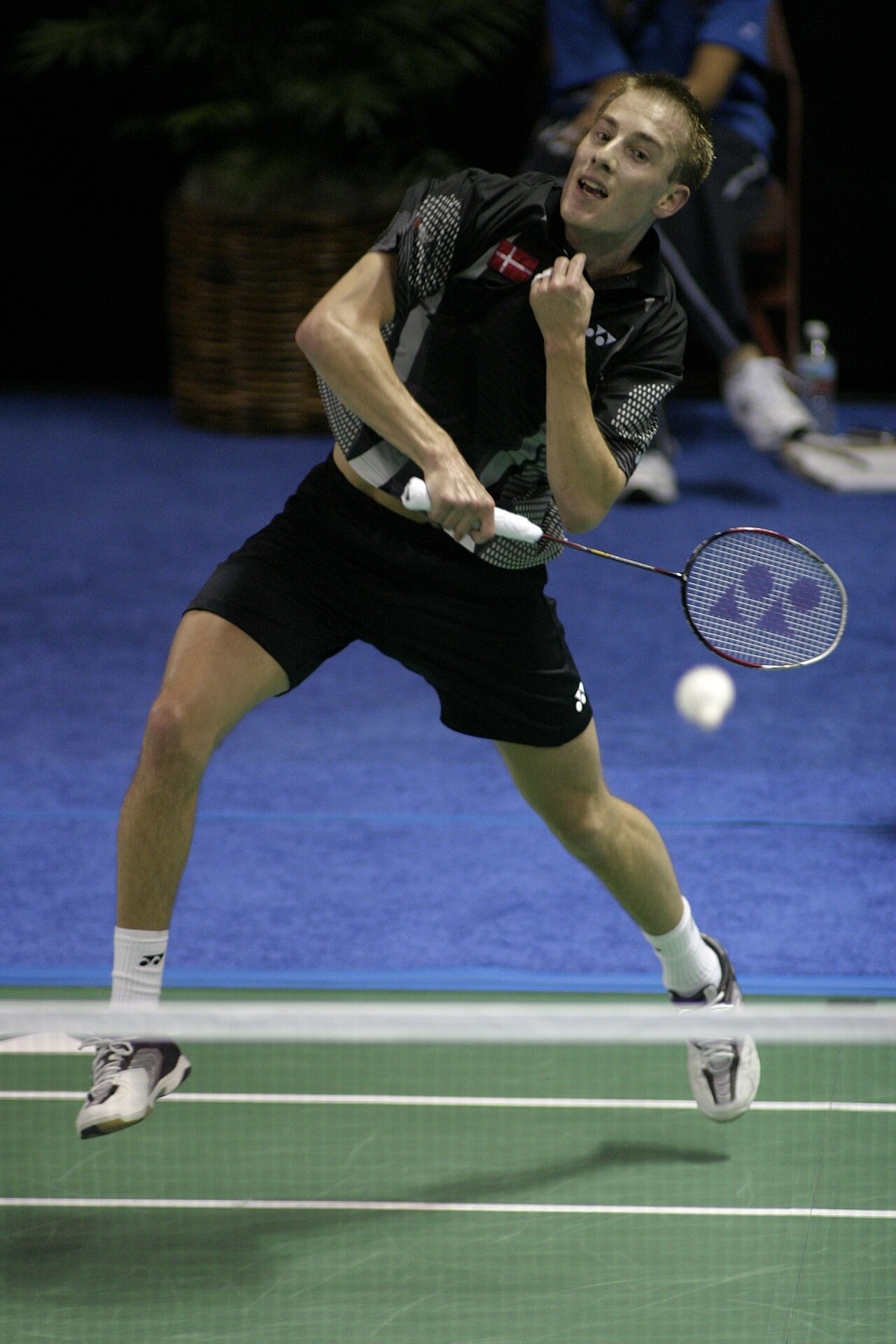
Badminton footwork is dominated by explosive lunges in every direction, split-step recoveries, and jump-landings under a racket that's already loaded for the next shot. Researchers who study the sport's biomechanics describe it as jump-landings, cross-steps, side-steps, and lunges repeated hundreds of times per match — almost none of it in a straight line. A lunge to retrieve a net shot loads the heel with roughly 2.5–3 times body weight on landing; a jump smash can spike closer to 4 times body weight. Running shoes manage force moving in one direction (forward), so they concentrate cushioning and flex under the forefoot for toe-off and offer little support at the sides of the foot. Push a running shoe hard sideways into a lunge and the sole can't stabilize the load — the foot rolls off the edge of the midsole instead of staying planted.
Tennis shoes get closer but are tuned for a different court and injury profile: heavier, more durable outsole compounds built to survive abrasive hard courts and clay, plus a higher-cut upper for extra ankle coverage on a sport with more forward-running rallies. That extra weight and stiffness is the wrong trade for badminton, where matches are won on how fast you can change direction, not on outsole durability over years of outdoor wear.
This guide walks through the four decisions that actually separate a real badminton shoe from a generic court shoe, in the order they matter for injury prevention and performance:
- Outsole compound — gum rubber and grip on indoor surfaces
- Weight and construction — how fast the shoe lets your feet move
- Lateral and ankle support — what keeps your foot stable mid-lunge
- Cushioning — absorbing the repeated jump-landing forces above
We're not naming products or ASINs here — this is the decision framework, not a shopping list. For the racket side of your kit, see our badminton racket buying guide, built the same way: tradeoffs explained, no pay-to-rank picks.
Decision 1: Outsole compound — why gum rubber
The sole of a badminton shoe is the single most sport-specific part of the shoe, and the reason comes down to material, not just tread pattern.
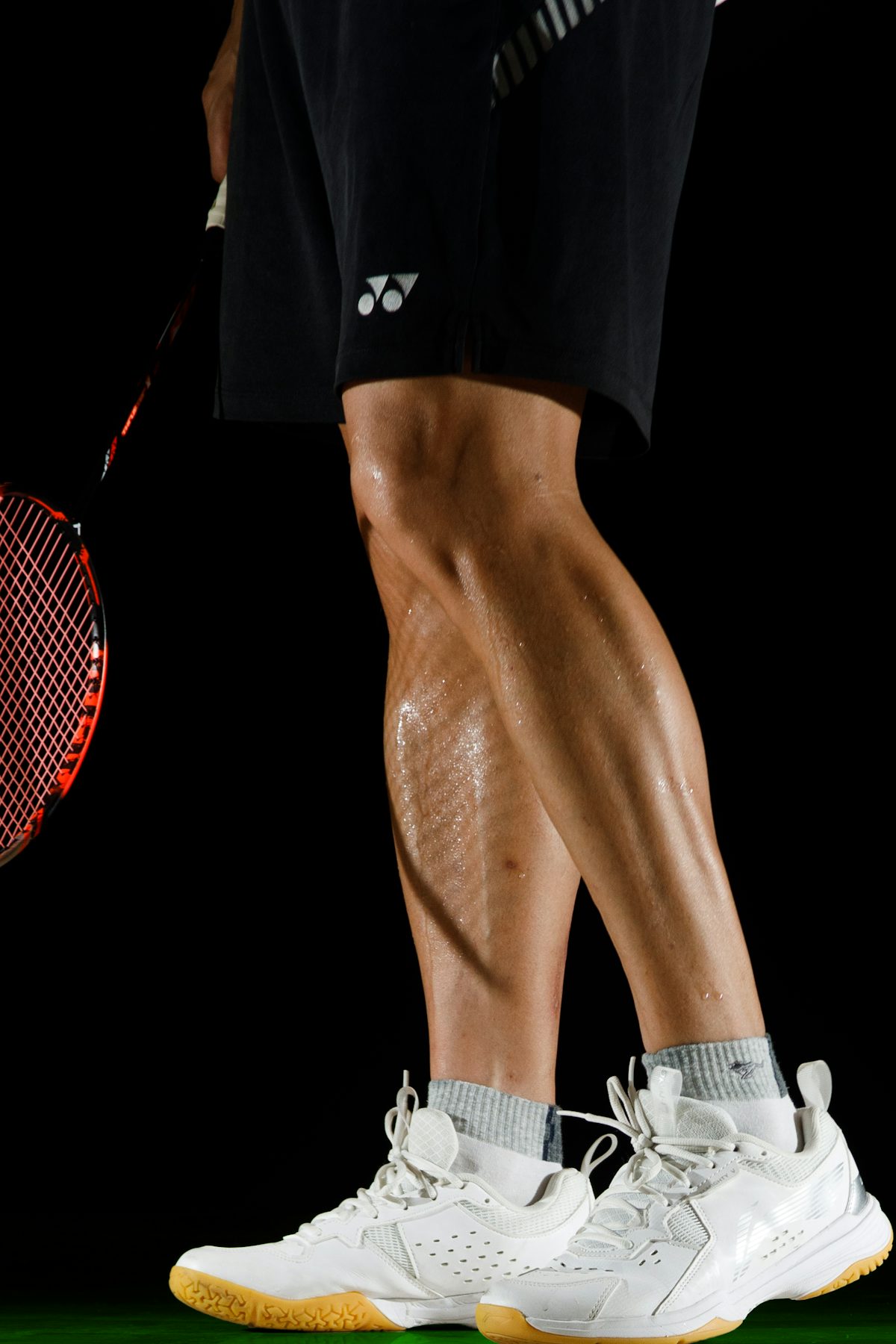
Gum rubber is the standard for a reason. Indoor badminton courts are typically wood, synthetic mat, or polished composite — smooth, low-friction surfaces by design, which means the floor also needs to let feet release cleanly out of a lunge, not just grip going in. Gum rubber (a natural-latex-derived compound, softer and tackier than the harder compounds used on running or trail shoes) bites into these surfaces on the way into a lunge and lets go cleanly on the way out, without the sticking or squeaking hard compounds produce. Standard street-shoe rubber does the opposite: it either skates on a polished indoor floor (dangerous mid-lunge) or grabs and holds too long — a fast way to twist a knee or ankle when your foot doesn't release with your body's rotation.
Non-marking matters, and it's not just about the floor. Most indoor badminton venues require non-marking soles — gum rubber typically qualifies, harder rubber compounds often don't. That's a practical access issue as much as a performance one: the wrong outsole can get you turned away at the door of a club that enforces the rule.
Tread pattern is the second layer. Herringbone or hexagonal tread patterns are common on dedicated badminton shoes because they bite into the surface directionally during a lunge and shed cleanly on recovery, unlike the straight-line lugs on a running shoe designed purely for forward propulsion.
What to check before buying: confirm the outsole is described as gum rubber (or an equivalent non-marking indoor-court compound) and rated for indoor court use specifically — not "multi-surface" or "outdoor court," which usually signals a harder, less grippy compound built for durability over indoor traction.
Decision 2: Weight and construction — fast feet, not durable feet
Once grip is solved, the next lever is how much shoe your feet have to move on every one of those hundreds of direction changes per match.
Why lightweight matters more here than in most racquet sports. A badminton rally is a chain of split-steps and lunges strung together with almost no recovery time between them — you're rarely stationary for more than a second. Every extra ounce of shoe has to be accelerated and decelerated on each of those steps, which compounds into real fatigue over a long session. It's the same logic that makes lightweight rackets easier to swing repeatedly, just applied to your feet.
The tradeoff is durability and cushioning volume, not safety. Lighter badminton shoes use thinner, more flexible uppers (mesh or synthetic weaves instead of leather) and pare down midsole material compared to running shoes built to survive hundreds of miles of repetitive-impact road use. That's a reasonable trade for a shoe used for match play a few hours a week on a controlled indoor surface, not daily outdoor mileage — though it does mean badminton shoes generally wear out faster than running shoes under heavy use. Expect a shorter replacement cycle if you play multiple times a week.
Flexibility at the forefoot is part of "lightweight," not separate from it. A stiff, running-shoe-style sole resists the quick toe-off and pivot that badminton footwork demands. Badminton-specific shoes are built to flex more readily at the forefoot so your foot can push off in whatever direction the next shot demands, not just straight ahead.
What to check before buying: compare stated shoe weight against your current sneakers (badminton shoes typically run lighter than an equivalent-size running shoe) and flex the forefoot by hand in the store or from product photos/specs — it should bend noticeably more easily than a running shoe's sole.
Decision 3: Lateral and ankle support — what actually prevents the sprain
This is the decision with the clearest injury stakes, and the one where the biomechanics research is the most specific.
Lateral ankle sprains are the single most common badminton injury, and they cluster around exactly the movements a match is built from: lateral lunges, backward lateral steps, and jump-landings where the foot touches down already rotated. A shoe with no lateral structure lets the foot roll sideways past its safe range of motion at exactly the moment the ankle is most loaded and least able to self-correct.
What actually helps, per the research, is reinforced sidewalls and a stable midfoot/heel structure — not just a taller ankle collar. A study on badminton footwear found that firmer lateral-wedge support in the outsole shortened ground-contact time during sidestep movements and increased stiffness through the foot-ankle complex, both signs of a more stable landing. A separate review found the clearest biomechanical benefits came from moderate forefoot/torsional stiffness (resistance to twisting through the midsection) plus a rounded heel shape, which reduced peak impact loading rates during lunges. In plain terms: sole and midfoot construction do more stabilizing work than the height of the shoe around your ankle.
Low-profile isn't a compromise here — it's part of the design. Unlike tennis shoes, which often add a higher ankle cut for extra coverage, badminton shoes are typically cut low so the ankle keeps its natural range of motion for the pivots the sport requires, while the reinforced sidewall (not fabric height) does the job of stopping excessive roll. A cross-sectional survey of competitive players also found meaningful differences in reported foot problems tied to shoe fit and to which leg was the player's dominant lunging leg — a reminder that "support" isn't one-size-fits-all, and fit matters as much as any single spec.
What to check before buying: look for an explicitly reinforced sidewall or midfoot wrap (badminton brands each have their own marketing name for this — "power cushion," torsion plates, lateral support panels), a low-to-mid ankle cut, and, where available, a rounded rather than sharply squared heel shape.
Decision 4: Cushioning — absorbing the jump-landing load
The last decision is how the shoe manages the repeated high-force impacts that badminton's jumping and lunging generate, which is a different problem than the cushioning most running shoes solve.
The forces are real and repetitive. As covered above, a hard lunge can load the heel at roughly 2.5–3 times body weight, and a jump smash landing can spike well beyond that. Unlike running, where impact forces are lower per-step but repeated thousands of times over a session, badminton delivers fewer total impacts at a higher peak force per landing, often at odd angles from landing mid-rotation or off-balance. Cushioning has to absorb that spike without collapsing, or the shock transfers straight through to the heel bone and shin.
Why cheap foam falls short under badminton's specific load. Under a high-velocity jump-smash landing, low-quality foam midsoles can "bottom out" — compress to their maximum and stop absorbing energy — transferring the remaining shock directly into the foot and lower leg. Quality badminton shoes generally use a dedicated shock-absorbing layer (foam, gel, or air-cushion inserts) concentrated at the heel and forefoot, engineered for spike-loading rather than the steady, lower-magnitude impact running shoes are tuned for.
Cushioning and lateral support are in tension, and that's fine. More cushioning generally means a softer, thicker midsole, which can slightly reduce the ground-feel and stability that hard lateral cuts benefit from. That's why badminton shoe design (per the research cited above) tends to favor a firmer platform than a plush running shoe, while still concentrating cushioning at the heel and forefoot rather than padding the entire sole uniformly. A well-built badminton shoe manages both by putting each property where it's needed most, not by choosing one over the other.
Who should prioritize cushioning most. If you play multiple sessions a week, if your matches run long, or if you have any history of knee, shin, or heel pain, weight cushioning more heavily even if it costs a little outright lightness. A shoe that's slightly heavier but properly absorbs jump-landing force will keep you playing longer than a featherweight shoe that transfers shock straight to your joints.
What to check before buying: a stated shock-absorbing midsole technology (branded foam, gel, or air systems are common across manufacturers) concentrated at the heel and forefoot — weighed against how often and how hard you play. Recreational once-a-week players can lean lighter; frequent players and anyone nursing a joint issue should lean toward more cushioning.
Putting it together
| If you are... | Prioritize |
|---|---|
| New to badminton, playing casually | Confirm non-marking gum-rubber outsole first — everything else is secondary until you're playing regularly enough to notice the other differences |
| Playing multiple sessions a week | Weight and cushioning — fatigue and jump-landing volume both compound with frequency |
| History of ankle sprains | Lateral/midfoot support and a firmer, lower shoe over a plush one |
| History of knee, shin, or heel pain | Cushioning quality (a real shock-absorbing midsole layer, not just a thick one) over raw lightness |
| Competitive or high-intensity singles player | All four factors matter roughly equally — this is where a genuine badminton-specific shoe (versus a generic "court shoe") earns its price difference |
None of these four decisions works in isolation — a shoe with great grip and no lateral support just gets your foot stuck in place while your ankle keeps rotating past it. Buy for the actual movement pattern of the sport, not for a shoe that happens to look athletic.
Sources
- Advances in Badminton Footwear Design: A Systematic Review of Biomechanical and Performance Implications (MDPI Applied Sciences)
- Dose–Response Effect of Incremental Lateral-Wedge Hardness on the Lower Limb Biomechanics During Typical Badminton Footwork (Journal of Sports Sciences, via Taylor & Francis)
- Influence of Torsional Stiffness in Badminton Footwear on Lower Limb Biomechanics (PMC / National Institutes of Health)
- Does Shoe Heel Design Influence Ground Reaction Forces and Knee Moments During Maximum Lunges in Elite and Intermediate Badminton Players? (PLOS ONE)
- Gender and Leg-Dominance Differences in Shoe Properties and Foot Injuries in Badminton: A Cross-Sectional Survey (Journal of Foot and Ankle Research, Wiley)
- Intelligent Prediction of Lower Extremity Loadings During Badminton Lunge Footwork in a Lab-Simulated Court (PMC / National Institutes of Health)
Once your feet and racket are sorted, the next step is finding somewhere to play. The Court Scout maintains a verified directory of badminton courts, with every venue we've added confirmed against a primary source. Find badminton courts near you and put the framework to work.