A framework, not a shopping list
Tennis shoes get treated like an afterthought by players who'll happily spend $250 on a racquet and then grab whatever cross-trainer is in the closet. That's backwards. Your racquet touches the ball for milliseconds per shot; your shoes are in contact with the court for the entire match, absorbing every sprint, plant, and slide. The wrong outsole on the wrong surface loses you traction exactly when you need it; a running shoe instead of a court shoe leaves you one hard lateral cut from a rolled ankle.
We're not going to hand you a "top 10 tennis shoes" list. As with our tennis racquet guide, tennis is still new to The Court Scout's directory, and we haven't yet run the kind of controlled, hands-on testing across dozens of shoes that would let us stand behind specific product picks. What we can give you instead is a clear decision framework, built from how tennis shoes are actually engineered and tested, so you know what to look for regardless of which brand you end up buying.
The five decisions, in the order they should drive your choice:
- Court surface compatibility — the outsole pattern that matches where you actually play
- Lateral support and stability — the structural features that protect your ankles during cutting movements
- Cushioning — how much shock absorption your body and your surface actually need
- Toe durability — surviving the toe drag that destroys shoes from the outside in
- Fit — the sizing and width decisions that determine whether any of the above even matters
Work through them in order. Court surface comes first because it's the decision every other spec has to accommodate — a shoe with perfect cushioning and support is still the wrong shoe if its outsole was built for a different surface than the one you play on.
Decision 1: Court surface compatibility
Tennis is played on at least three structurally different surfaces, and shoe manufacturers build distinct outsole tread patterns for each one. Buying a shoe built for the wrong surface isn't a minor mismatch — it changes how your foot actually grips the court.
Hard court: modified herringbone. Hard courts (acrylic-coated asphalt or concrete, the most common surface in the US) are abrasive and unforgiving. Hard court outsoles use a modified herringbone pattern — a less dense, more "open tread" version of the classic zigzag — that balances grip with controlled glide during slides and stops, built in thicker, tougher rubber because the surface chews through soft rubber fast. If concrete or acrylic is where you play most, prioritize a durable, non-marking outsole.
Clay court: full herringbone. Clay shoes use a deep, uniform herringbone tread running the full length of the outsole. The dense zigzag lets clay particles fall through the grooves instead of packing into the tread, and it's engineered to let you slide into shots in a controlled way — a core part of clay-court movement that doesn't really exist on hard courts. Because clay is softer and more forgiving than concrete, clay shoes get away with thinner, lighter soles that prioritize flexibility over raw durability.
Grass court: nubs or pimples. Grass shoes replace tread altogether with small rubber nubs or pimples, closer to a cleat than a conventional outsole, because grass is slippery in a different way than clay or hard courts. These are surface-specific to the point of being unusable elsewhere, and most recreational US players will never need a pair since grass courts are rare outside private clubs and tournaments.
All-court: the practical default. All-court shoes flatten and densify the clay-style herringbone, aiming for a tread that grips reliably on hard courts while still tolerating occasional clay play. If you split time between surfaces, or aren't sure which you'll play most, all-court is the sensible default — you give up a bit of surface-specific performance for one pair that works almost everywhere.
The takeaway: identify your primary surface first, then shop within that outsole category. A hard-court shoe on clay fights you on every slide; a clay shoe on hard courts wears through in a fraction of its expected life.
Decision 2: Lateral support and stability
Running shoes are built almost entirely around forward motion. Tennis is built around the opposite: constant lateral cuts, hard stops, split-steps, and direction reversals that put enormous side-loading stress on your ankles and feet. That's the single biggest reason "just wear running shoes" is bad advice for tennis — running shoe midsoles and outsoles aren't designed to resist the sideways forces tennis generates.
Purpose-built tennis shoes address this with a few structural features worth knowing so you can spot them on a spec sheet or in a shop:
Outriggers — a flared, widened section of outsole along the outer edge. It extends the base of support sideways, so if your foot starts to roll onto its side during a hard cut, the outrigger catches the court and interrupts the roll before your ankle ligaments take the load.
Midfoot shank / torsional rigidity — a firmer insert, often TPU or a similar rigid plastic, built into the midsole under the arch. It resists the shoe twisting along its length during a lateral plant — the twisting motion that precedes an inversion ankle sprain.
A wide, low platform and a firm heel counter — tennis shoes sit lower and wider than running shoes, lowering your center of gravity for stability, and a well-fitted heel counter (the rigid cup around your heel) keeps your heel locked in place during quick stops instead of sliding inside the shoe.
If a shoe is marketed purely on cushioning or weight and says nothing about lateral support, stability, or torsional rigidity, treat that as a signal it may be a repurposed running or cross-training shoe rather than one engineered for tennis's cutting movements.
Decision 3: Cushioning
Cushioning is where court surface and your own body come back into the decision. Tennis shoe midsoles absorb repeated high-impact loading — sprints, stops, jumps on serves — and how much you need depends on what you're playing on and how your body tolerates impact.
Hard courts demand more cushioning. Because acrylic and concrete don't give at all, every footfall's impact energy has to be absorbed somewhere — and if the shoe doesn't absorb it, your knees, shins, and lower back do. Prioritize substantial midsole cushioning over shoes optimized purely for lightness if hard courts are your main surface. Clay, by contrast, has natural give, so clay shoes get away with thinner, lighter builds without punishing your joints.
The tradeoff: cushioning vs. stability. More midsole foam means a softer ride and less joint stress, but also a taller, less stable platform for cutting — the same "stack height vs. stability" tradeoff seen in running shoes. Look for cushioning concentrated where impact actually lands (heel and forefoot), paired with a firmer, more structured midfoot that preserves the lateral stability from Decision 2.
Weigh your own factors. History of knee, shin, or lower-back pain, or a hard-court-heavy schedule? Lean toward more cushioning. Lighter player, mostly on clay, prioritizing touch at net? A firmer, lower-profile shoe is a reasonable tradeoff the other way.
Decision 4: Toe durability (the toe-drag problem)
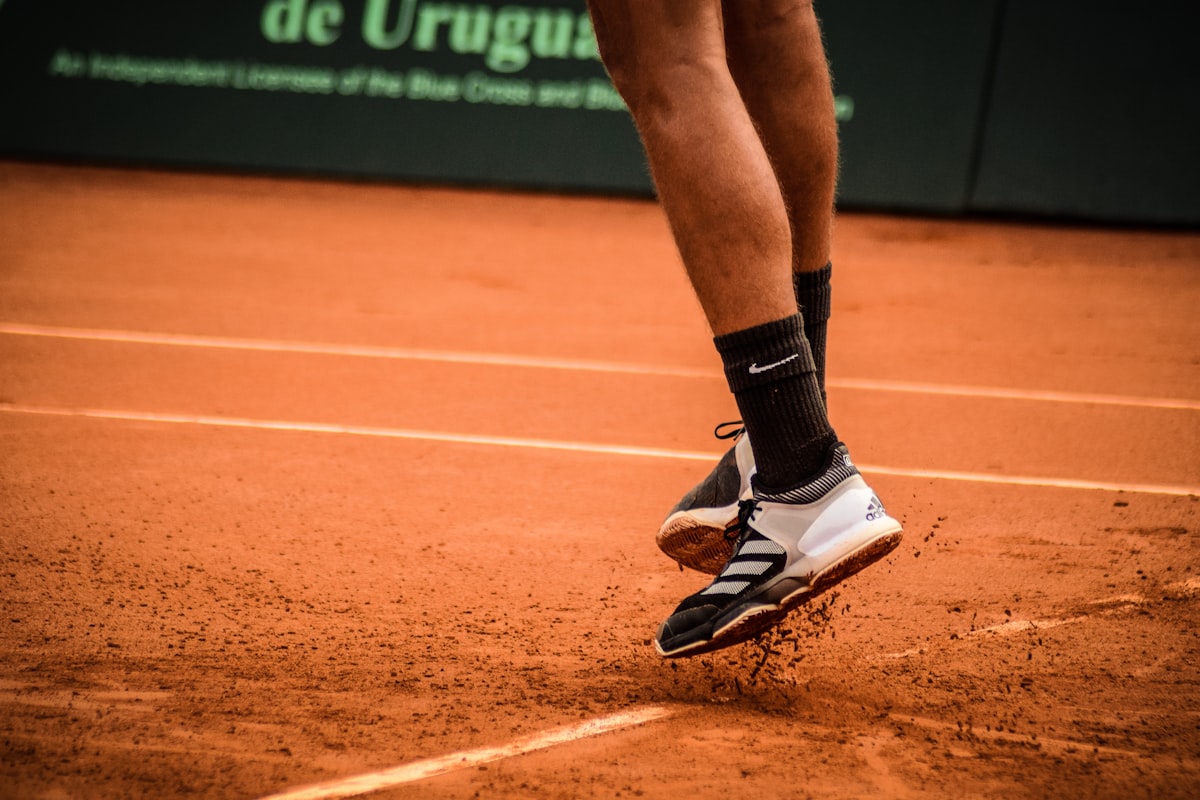
If you've ever seen a shoe with a hole worn clean through the toe box, you've seen toe drag in action. Many players — particularly those hitting a heavy topspin or kick serve — drag the toe of their back foot across the court on the follow-through. Over months of play, that repeated friction can wear straight through a standard shoe upper, well before the sole or cushioning has worn out.
What to look for. Reinforced toe panels — sometimes marketed as a toe guard, toe cap, or drag protection zone — add tougher, abrasion-resistant material (rubberized overlays or dense synthetic panels) across the front and medial (inner) side of the shoe, exactly where a dragging toe makes contact. Check for this explicitly rather than assuming any tennis shoe has it built in.
It's a mitigation, not a cure. Reinforced toe panels extend a shoe's life under toe-drag stress but don't eliminate it. If drag is severe and habitual, fixing the serve mechanics that cause it (with a coach) is the only real fix — the shoe just buys more matches before you're shopping again.
Durability is also a surface and a weight question. Hard courts wear down outsoles and toe panels far faster than clay does, simply because concrete and acrylic are more abrasive — weigh durability more heavily if you're a hard-court player who drags a toe. Ultra-lightweight shoes compound the problem: less material and softer compounds save weight but wear faster. A common workaround is keeping a durable, heavier pair for practice and league play and reserving a lighter pair for matches that matter.
Decision 5: Fit
None of the above matters if the shoe doesn't fit. A perfectly cushioned, perfectly supportive shoe in the wrong size will still slide during a lateral cut, still blister your heel, and still fail to protect your ankle the way its structural features are designed to.
Measure both feet, standing, in tennis socks. Feet swell during a match and are rarely perfectly symmetrical — measure both and fit to the larger, and measure in the socks you'll actually play in, not barefoot.
Leave room at the toe, but not too much. A common rule of thumb is roughly a thumb's-width between your longest toe and the front of the shoe when standing. Too tight, and hard stops jam your toes on every deceleration — a fast way to lose toenails over a season. Too loose, and your foot slides forward inside the shoe on stops, undermining the stability features from Decision 2 no matter how good they are.
Check width, not just length. Standard widths run D for men's and B for women's, but wide (2E, 4E) and narrow options exist from most major brands. The right length in the wrong width will either pinch (numbness, blisters, bunion pain) or let your foot shift side to side during lateral movement.
Break-in expectations. Tennis shoes shouldn't need a long break-in the way stiff hiking boots do. Some initial stiffness is normal, but persistent pinching or hot spots after a couple of wears means the fit is wrong. Most reputable tennis retailers accept returns for fit issues — use that instead of playing through pain.
The decision framework, summarized
| If you mostly play on... | Prioritize outsole | Cushioning lean | Extra consideration |
|---|---|---|---|
| Hard courts (concrete/acrylic) | Modified herringbone, durable rubber compound | More cushioning (impact-absorbing) | Toe/outsole durability matters most here — most abrasive surface |
| Clay courts | Full herringbone (deep zigzag) | Can run lighter/less cushioned | Prioritize controlled slide over raw grip |
| Grass courts | Nubs/pimples (surface-specific) | Standard | Cannot double as a hard or clay shoe |
| Multiple surfaces / unsure | All-court (flattened, dense herringbone) | Balanced | Accept a small performance tradeoff on any single surface for versatility |
Regardless of surface: check for outriggers, a midfoot shank, and a snug heel counter; check for reinforced toe panels if you're a toe-dragger; and measure both feet in your actual tennis socks before committing to a size.
A closing honest note
The shoe that performs best on paper is the one you'll actually wear until the tread wears down — not the one sitting in a box because you're worried about scuffing it. Match the outsole to your real court surface, make sure support and cushioning suit how your body handles impact, check toe durability if you're a dragger, and get the fit right before anything else matters. Work through those five decisions and you'll know enough to walk into any tennis shop and tell whether a shoe is actually right for your game — no top-10 list required.
Sources
- Tennis Warehouse — How to Choose the Right Tennis Shoes
- Tennis Warehouse — Outsoles Explained: Hard vs. Clay vs. Grass
- Tennis Express — Clay Court vs. Hard Court Tennis Shoes: What's the Difference?
- Merchant of Tennis — Why Court Surface Matters
- Holabird Sports — How to Choose Durable Tennis Shoes
- USTA — official site
- ITF — Approved Rackets and Equipment
Once you have the right shoes, you need somewhere to wear them in
Our tennis racquet buying guide covers the other half of your gear decision — head size, weight and balance, string pattern, and grip. And The Court Scout maintains a verified directory of tennis courts, checked against primary sources rather than scraped guesswork. Find tennis courts near you to try out your new shoes.