Why the game slows down at the net
Watch a rally between two 4.0+ teams and you'll notice something that looks nothing like the rest of the sport: for ten, fifteen, sometimes twenty-five shots in a row, nobody is trying to hit a winner. The ball barely clears the net. It lands soft, close, and low, over and over, while four players stand almost still at the kitchen line. To a beginner watching from the sideline, it looks like nobody wants to finish the point. To the players in it, it's the whole point — the dink rally is where pickleball is actually decided, and the team that breaks patience first almost always loses.
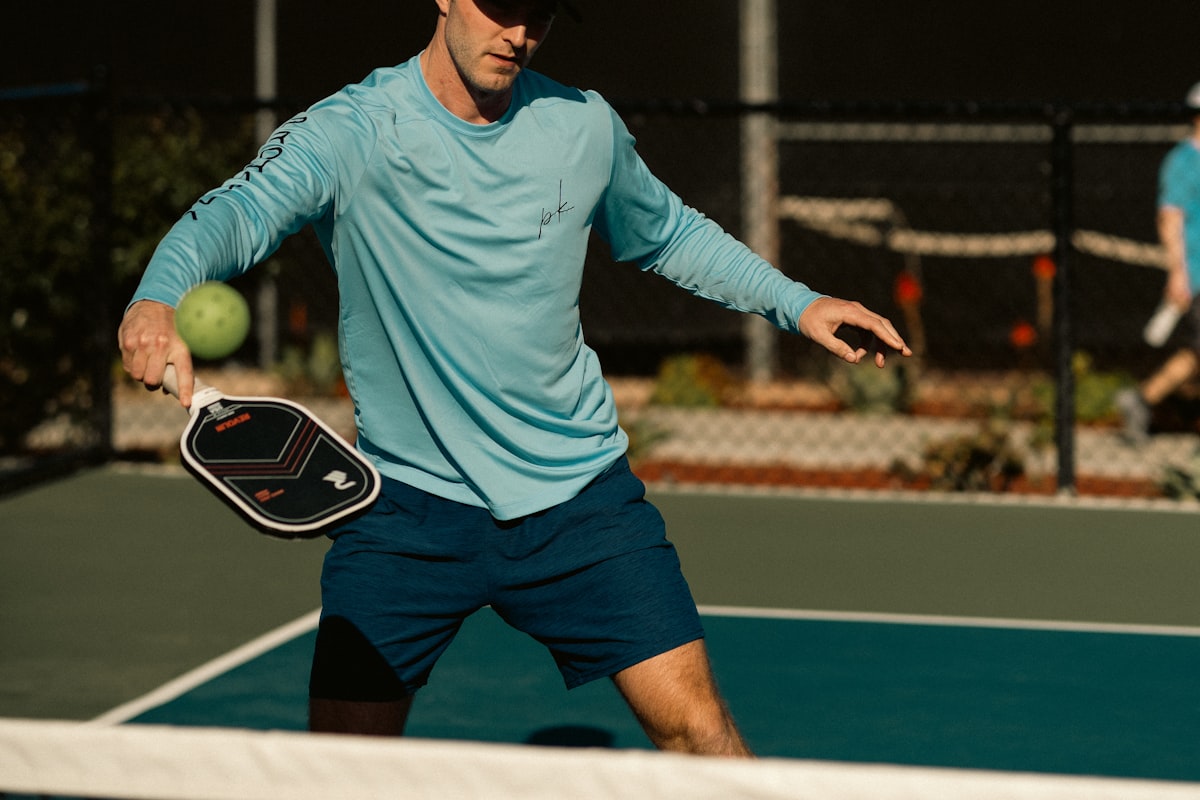
A dink is a soft, controlled shot, hit from at or near the non-volley-zone line, that arcs just over the net and drops into the opponent's kitchen before it has a chance to rise back above net height. It's not a defensive shot and it's not an attacking shot — it's a neutral shot, deliberately hit low and slow so the opponent can't attack it either. Once both teams are at the kitchen line (which, per pickleball's non-volley-zone rule, neither side can enter while volleying), dinking is how the point gets negotiated: back and forth, low ball after low ball, until someone gets a ball that sits up just enough to be attackable, or someone gets impatient and attacks one that isn't.
This guide assumes you already know the broader shape of pickleball strategy — get to the kitchen, hit a third-shot drop, don't drive into paddles at net height. If you haven't read that yet, start with our pickleball strategy basics guide, which covers all eight fundamentals at a survey level, dinking included. This piece goes deep on that one shot: the two directions you can hit it, the patience it demands, the reset that saves you when you're in trouble, the mistakes that give points away for free, and two drills that build the pattern into muscle memory.
What actually makes a dink hard to attack
Before getting into shot selection, it's worth understanding the physics that make dinking work, because every tactical decision below flows from it.
A ball that's below net height has to be hit upward to clear the net, and a ball hit upward has an arc: it rises, peaks, and comes back down. Swing at a low ball with any real pace and that arc carries it well past the kitchen line before it descends — right into the strike zone of an opponent standing at the net with a paddle already up. That's a free smash, and it's the single most common way points get given away at the intermediate level.
A dink solves this by using almost no pace at all. You lift the ball with soft hands rather than swinging at it, so it just barely clears the net and drops again immediately — inside the opponent's kitchen, below net height, before they can meet it out of the air. They're now in the exact same bind you were just in: forced to hit up, off a low ball, with no ability to attack. The rally continues on those terms until somebody's dink drifts high enough — above net height — that it becomes attackable. That's the moment the neutral shot turns into a winner, and good dinking strategy is about making that moment happen on your terms, not the opponent's.
Cross-court dink vs. straight (down-the-line) dink
Every dink you hit travels one of two directions relative to the net, and the choice matters more than most beginners realize.
The cross-court dink travels diagonally, from your side of the court to the opposite side of your opponents' court — the same diagonal the serve travels on. It's the standard, default dink for two structural reasons. First, the net is lower in the middle (34 inches) than at the sidelines (36 inches), so hitting cross-court naturally routes the ball over the lower, safer part of the net. Second, the cross-court diagonal is longer than the straight line in front of you — more net-to-target distance means more margin for error and a longer window for the ball to complete its short arc and drop before your opponent can attack it.
The straight (down-the-line) dink travels directly across the net to the player standing right in front of you, on the shortest possible line. It's a legitimate shot, but higher risk: the distance is shorter, so there's less room for the ball to drop before it reaches your opponent, and you're hitting into a part of the net that's two inches higher. Straight dinks are used deliberately, not as a default — most often to change the rhythm an opponent has settled into during a long cross-court exchange, to attack a weaker backhand, or to punish a partner who has drifted too far toward the middle to defend the line in front of them.
The practical rule most coaches teach: default to cross-court, and use straight dinks as a change-up, not a habit. If you dink straight every time, you're playing the higher-risk shot for no strategic reason. If you never dink straight, you become predictable and an alert opponent will start creeping over to cut off the cross-court dink before it even arrives. The best dinkers mix in just enough straight dinks to keep the opponent honest, without abandoning the safer cross-court shot as their base.
Patience and shot selection: why attacking early loses points
The single hardest discipline to learn in dinking is also the simplest rule to state: you don't attack a ball that's below net height, full stop. If the ball crosses the net below the white tape, the only sound response is another soft, low shot back — a dink or a reset. The instant it floats up above net height, the calculus changes and you're allowed to speed it up.
Beginners break this rule constantly, almost always for an emotional reason rather than a tactical one: dink rallies feel slow and uneventful, and there's a strong urge to "just end it" by taking a swing. That urge is exactly what a patient opponent is waiting for. A ball hit with pace off a below-net-height ball nearly always pops up — the extra speed forces a less controlled paddle angle, and the geometry above simply doesn't allow a hard, flat shot to clear the net without carrying long. Either way, you've just handed your opponent the exact attackable ball you were trying to create for yourself.
The correct mindset flips the goal of a dink rally on its head: you are not trying to win the point with any individual dink. You are trying to survive long enough, without giving your opponent anything to attack, that they eventually give you something to attack. Elite dink rallies at 4.5+ routinely run fifteen to twenty-five shots before anyone gets a truly attackable ball — and the team that keeps its discipline for those shots wins the point almost every time, because eventually somebody's dink sits up a fraction of an inch too high, or lands a fraction of a second too shallow.
Two habits reinforce the patience: aim for depth into the kitchen rather than just clearing the net (a dink that lands near the kitchen line gives your opponent a much harder low ball to deal with than one landing right at the net), and vary your target — middle, body, wide angle — so the opponent can never fully set their feet.
The reset shot: what to do when you're under pressure
Not every ball you receive at the kitchen line is a comfortable, easy-paced dink to redirect. Sometimes an opponent's shot arrives faster and lower than a dink should be — a hard, low drive at your feet, or a dink that skids low off a bounce — and you're suddenly in trouble with no time to set up a normal dink.
That's the moment for a reset: a soft, controlled block that absorbs the incoming pace and drops the ball, low and unattackable, back into the opponent's kitchen — functionally the same shot as a third-shot drop, but hit reactively, from wherever your feet happen to be. The technique is soft hands, not a swing: let the paddle face absorb the ball's speed rather than adding your own pace, keep the face slightly open, and use a small lift from the wrist rather than a full stroke. The goal isn't offense — it's simply to not lose the point, and to buy your team another ball to work with.
The mental shift that separates strong dinkers from beginners is accepting that not every shot has to be a winner — some shots just have to not be a mistake. A well-executed reset off a hard ball that drops dead in the kitchen is, in a real sense, just as valuable as an aggressive put-away — it keeps the rally alive and denies the opponent the point they were trying to force. Players who try to match every hard incoming ball with an equally hard return are the ones who lose kitchen battles; players who can calmly reset under pressure extend rallies long enough to eventually get the ball they can attack.
Common dinking mistakes
Popping the ball up. This is the single most common and most costly dinking error. It happens when the paddle face is too open on contact, or when a player tries to "lift" a low ball with too much force instead of a small, controlled touch. The result is a dink that clears the net far higher than intended, giving the opponent an easy put-away. The fix is almost always paddle-face angle and a shorter, softer stroke — practice hitting dinks that just barely clear the net rather than ones with a big, safe-looking arc.
Dinking too hard. Related but distinct from popping the ball up: a dink hit with real pace, even if it doesn't rise above net height, is much harder to control for depth and direction, and it's more likely to sail long or wide. Dinking is a touch shot, not a speed shot; the goal is control, not power.
Standing too far back from the kitchen line. Every extra step you stand back from the non-volley-zone line gives your opponent more room to drop a soft dink in front of you that you now have to move forward and down to reach — often forcing you to hit up on a ball you'd have handled cleanly at the line. Players who camp a foot or two behind "for safety" are giving away the exact geometric advantage the line is supposed to provide. The correct position is right at the line, paddles up, weight forward — close enough that a short dink is still reachable without a lunge. And when a dink is wide or short, move your feet to get behind it rather than reaching with an outstretched arm; reaching produces a weak, unbalanced paddle angle almost every time.
Two drills to build the pattern
Cross-court dinking drill (10 minutes). Two players, both at the kitchen line on the same diagonal, dink cross-court only — no down-the-line, no attacking. Count consecutive dinks that land in the kitchen; reset the count on any error. Start with a goal of 15 in a row, then 25. This drill builds the touch, the patience, and the habit of staying at the line simultaneously — most players' first honest attempt tops out well under 10.
Pressure-reset drill (10 minutes). One player feeds hard, low balls from the kitchen line — some at the body, some at the feet, some wide — while the partner practices resetting each one into the opponent's kitchen with soft hands. Rotate roles after ten feeds. This is the drill most players skip because it isn't fun, and it's exactly why it's valuable: the reset is a reactive skill, and reactive skills only improve under repeated, deliberate pressure, not in a comfortable, predictable dink rally.
Run both drills for a combined 20 minutes, twice a week, and the patience/reset instincts described above stop being something you consciously think about mid-point and start becoming your default.
Take the kitchen battle to a real court
Dinking strategy only sticks once you've run it against live opponents who are trying to bait you into attacking too early — reading about patience is not the same as feeling the urge to speed up a ball and choosing not to. The Court Scout maintains a verified directory of pickleball courts across the US, and most outdoor locations run open-play sessions where you'll rotate through games against a mix of skill levels — a good, low-stakes place to grind out dink rallies against real opponents. For the rest of the strategic picture beyond the kitchen — third-shot drops, stacking, poaching — see our pickleball strategy basics guide, and for the underlying non-volley-zone rule that makes dinking necessary in the first place, see our pickleball rules guide.
Sources
This guide draws on USA Pickleball's official rules and strategy resources, plus the same long-form instructional coaching (Sarah Ansboury, Briones Pickleball, The Pickler) already cited in our broader strategy guide, cross-referenced specifically for their dinking, reset, and kitchen-positioning content.