The net, not the baseline, wins doubles
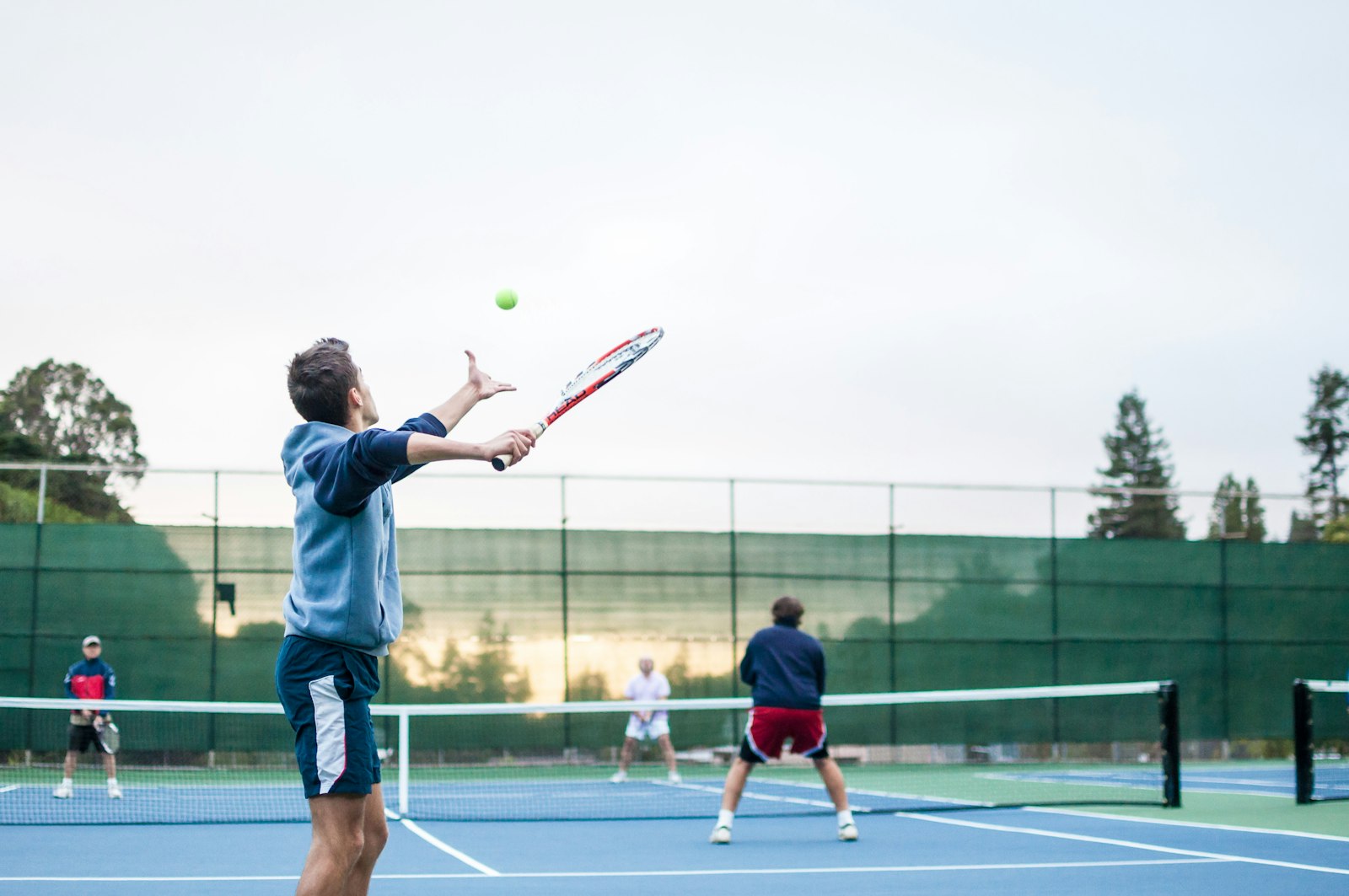
Watch a few minutes of recreational doubles next to a few minutes of singles and the difference is visible before anyone hits a ball with real pace: doubles players spend most of the point standing near the net, not camped on the baseline trading groundstrokes. That's not habit. It's the correct response to the geometry of a doubles court, and understanding why is the fastest way to get better at the format.
Two players share a court that's only slightly wider than a singles court (the doubles alleys add 4.5 feet per side, for a total width of 36 feet against singles' 27), so there's proportionally less open space to defend once both players close in on the net. A team standing at the net together covers nearly the full width of the court with two rackets and much shorter reaction distances than a team standing at the baseline. That single fact — net position shrinks the court you have to defend — is the foundation for almost everything else in this guide: why teams rush the net after serving, why poaching works, why communication matters more than it does in singles, and why doubles points tend to be shorter and more decisive than singles rallies.
If you haven't already, it's worth reading our guide to how tennis scoring works first — the point-game-set structure doesn't change between singles and doubles, only the tactics for winning individual points do. If you're building or upgrading your gear for a season of doubles, our guide to choosing a tennis racquet covers the head size, weight, and string pattern tradeoffs that matter regardless of format. And if you split time between formats, our singles strategy guide is the direct counterpart to this piece — the same court, tactics that point in almost the opposite direction.
Why doubles is a net-rushing game
In singles, a player who reaches the net without earning the position first is often exposed — one good passing shot or lob down the open baseline ends the point. Doubles removes that vulnerability. With a partner also positioned forward, the two players together cover nearly the entire net area, leaving little clean passing lane and making a lob the main counter — one a mobile team can often track down and put away.
That's the logic behind serve-and-volley, the classic doubles opening: the server hits the serve and immediately advances toward the net rather than staying back to rally, aiming to reach the service line (or closer) in time to hit the first volley aggressively rather than defensively. It isn't unique to doubles — it was once common in singles too, before modern racquet and string technology made baseline power so effective that serve-and-volley singles largely disappeared from the pro game. In doubles it never went away, because the payoff (a two-person wall at the net) is bigger and the risk (an opponent passing you down an open lane) is smaller than in singles.
The numbers back this up. Point-tracking data on tour-level doubles, popularized by strategy analysts like Craig O'Shannessy, consistently shows the large majority of doubles winners are struck from the net rather than the baseline, and that points are decided in far fewer shots on average than singles rallies — first-strike tennis (serve, return, and the next shot or two) settles most doubles points, rather than extended baseline exchanges. Whatever the exact figure in any given data set, the pattern every instructional source agrees on is the same: doubles rewards getting to the net early and often, and baseline-only doubles is a losing strategy against a team willing to come forward.
Court positioning: one up, one back vs. both at net
There are two standard formations a doubles team uses, and knowing when each applies matters more than mastering either one in isolation.
One up, one back. One player holds the net while their partner stays at the baseline. This is the default formation for the returning team at the start of a point (the returner typically starts near the baseline to handle the serve, while their partner holds the net) and it's also common among newer players who haven't yet developed confident net games. Its strength: the baseline player can chase down lobs and deep shots a fully-forward team would struggle to reach, while the net player pressures anything hit short. Its weakness is that it's asymmetric — the baseline player isn't applying nearly the same pressure as the net player, and a good opposing team will target them relentlessly, since a rally against a one-up-one-back team is really a mismatch between one aggressive net presence and one player defending alone.
Both at net. Once the server reaches the net after their approach — or once the returning team advances together after taking control of a point — both players hold a line roughly at or just behind the service line, angled to cover the middle and the alleys as a unit. Instructional consensus, echoed by USTA's own doubles coaching material, treats both-at-net as the stronger formation once a team can execute it: two players at the net cut off nearly every angle except a well-placed lob, and 84% of winners in tracked doubles play are struck from the net rather than the baseline, per the O'Shannessy-sourced statistics widely cited in doubles coaching. The tradeoff is more exposure to a well-hit lob over their heads, which is why lob defense — tracking back, letting the overhead bounce if needed, and resetting rather than panicking — is treated as a core doubles skill rather than an occasional emergency.
The practical rule most coaches teach: start points in whichever formation your role requires (server and partner typically serve-and-volley into both-at-net; the returning team often starts one-up-one-back and works to advance together), and treat "get both players to the net" as the shared goal of every point, not just the server's job. A team that ends up with both players at the net, together, after a rally has almost always out-positioned a team that hasn't.
Poaching: the net player's most disruptive weapon
Poaching is when the net player crosses into their partner's half of the court to intercept a shot — most often a return of serve — that would otherwise have gone to the partner. Done well, it's one of the most disruptive tactics in doubles: it turns a ball the opponent expected to go past the net player into an aggressive volley or put-away, and it forces opponents to second-guess where they can safely hit the ball for the rest of the match, even on points where no poach happens. None of it works without a reliable volley underneath it — our tennis volley technique guide covers the short-punch mechanics and footwork that turn a poach from a lunge into a clean put-away.
Timing separates an effective poach from a wasted one. The generally taught cue is to move just after the returner has committed to their swing — early enough that the net player can intercept the ball before it crosses the middle, but late enough that the returner can't redirect their shot to exploit the gap being left open. Coaches consistently warn against hesitating once the decision is made: a half-committed poach is worse than no poach at all, because it neither covers the middle nor holds the original position.
Poaching only works, though, if the server knows it might happen — which is exactly why doubles teams communicate before nearly every point.
Communication between partners
Singles players compete alone; doubles players compete as a coordinated pair, and the strategy above only functions if both players are working from the same plan. That coordination shows up in two forms.
Between points. Before most service points, especially at intermediate and advanced levels, the net player signals their intent to the server — typically with a hand held behind their back, out of the opponents' sight line: a closed fist commonly signals "I'm staying," while an open hand signals "I'm going to poach." Some teams add a third signal for a fake poach — a movement toward the middle with no intent to intercept, meant purely to unsettle the returner. The point isn't secrecy for its own sake; it's making sure the server knows to cover the alley the net player is about to vacate, since a poach only works as a team play — a net player who poaches without warning their partner just leaves their own side of the court open.
During points. Once the ball is in play, doubles partners talk constantly, and the two most common words in any doubles match are simple calls for shared responsibility: "mine" or "yours" for balls hit down the middle that either player could reasonably take, and "back" or "up" as a team decides together whether to retreat for a lob or hold the net. This isn't optional politeness — a ball hit into the gap between two silent partners is one of the most common ways doubles points are lost, because both players assume the other is covering it.
None of this exists in singles, which is worth dwelling on for a moment, because it's the clearest way to see how differently doubles strategy actually works.
How doubles strategy differs from singles, concretely
The point-scoring skeleton is identical between formats — love, 15, 30, 40, deuce, and the rest work exactly the same whether two players or four are on court, as covered in our tennis scoring guide. Strategically, though, doubles and singles are close to different sports played on overlapping courts:
- Points are shorter and decided closer to the net. Singles rallies are frequently extended baseline exchanges settled by a well-placed groundstroke or a deep error. Doubles points are more often decided in the first few shots — serve, return, and the next ball — because getting to the net changes the math on who can finish the point.
- Net play dominates over baseline play. A singles player who rushes the net without setting the point up first is often passed. A doubles team that reaches the net together is, by most tracked data and coaching consensus, in the strongest position on the court — the opposite of the relationship singles players are used to.
- Serve-and-volley remains a live, common tactic. It's largely disappeared from elite singles, where baseline power off modern racquets and strings makes staying back the higher-percentage play, but it's still a standard doubles opening because a two-person net presence is so much harder to pass than a one-person one.
- The court is wider but strategically more constrained. Doubles adds the alleys, but a team positioned correctly at the net has less real open space to defend per player than a lone singles player at the baseline, because two rackets close together cut off far more angles than one racket alone.
- Partner coordination replaces individual shot-making as the deciding skill. A technically weaker doubles team that communicates well, covers the middle, and gets to the net together consistently beats a stronger team playing as two individuals. Singles has no equivalent — there's no one to coordinate with, so the deciding factor is purely one player's shot-making and court coverage.
None of this means singles skills don't transfer — solid groundstrokes, a reliable serve, and good footwork help in both formats. But if you're used to singles and stepping into doubles for the first time, the biggest adjustment isn't technical. It's learning to treat the net, not the baseline, as home, and learning to play as half of a two-person unit rather than as a soloist who happens to share the court.
A well-placed, well-disguised serve still sets up almost everything above — our tennis serve technique guide covers the grip, toss, and flat/slice/kick spins that give a serving pair a real net-attacking opportunity instead of a neutral start to the point.
Sources
This guide draws on official doubles rules and instructional material from tennis's governing and national bodies, cross-referenced against widely cited doubles-specific point-tracking data and coaching commentary:
- USTA — Doubles Tennis Rules and Tips
- USTA — Improve Your Game: Poaching in Doubles
- ITF — Rules of Tennis, 2026 edition (PDF) (court dimensions and doubles-specific rules)
- Tennis Nation — Tennis Doubles Strategy and Positioning: Data-Driven Guide (doubles point-tracking statistics, sourced to a USPTA presentation by strategy analyst Craig O'Shannessy)
We have not independently re-run the point-tracking study behind the net-vs-baseline winner statistics above; we're reporting the figures as they've been consistently presented in doubles coaching material, not as our own original research.
Ready to put doubles strategy into practice? The Court Scout maintains a verified directory of tennis courts, built from primary sources rather than scraped listings. Find tennis courts near you and get a doubles match on the calendar.