Some links in this article are affiliate links. The Court Scout may earn a commission if you buy through them. This does not affect our recommendations — we never accept payment to feature a product, and our rankings are based on independent research of public reviews, manufacturer specs, and player feedback.
What to look for in a first paddle
If you just bought a sleeve of balls and your friend keeps inviting you to "try this pickleball thing," do not start by spending $250 on a thermoformed carbon fiber paddle the pros use. The grip you'll develop over your first 3 months will change. Your swing path will change. Your sense for where the sweet spot lives will change. A $79–$120 paddle that's forgiving on mishits will teach you more than a $250 paddle that punishes them.
The sweet zone for a beginner paddle is narrow and well-understood. Weight: 7.6–8.2 oz — heavy enough to absorb pace without flicking around, light enough not to shred your wrist after two hours. Core thickness: 16mm — the thicker the polymer honeycomb core, the larger and more forgiving the sweet spot. (Thinner 13mm cores trade forgiveness for power; you don't need power yet, you need consistency.) Shape: hybrid or widebody — elongated paddles look cool but the sweet spot moves closer to the tip and shrinks. A standard or widebody shape gives you the biggest target. Surface: fiberglass or composite over raw carbon — raw carbon paddles spin more but cost more and aren't where a beginner's improvements come from. What to skip: anything marketed as "thermoformed," "T700 carbon," "pro-level power" — that's gear for players whose technique has already plateaued at the rec level. Walk before you run.
Here are five paddles under $120 that consistently get recommended for new players across independent reviews, that we could verify are currently sold on Amazon, and that we'd hand to a friend without apology.
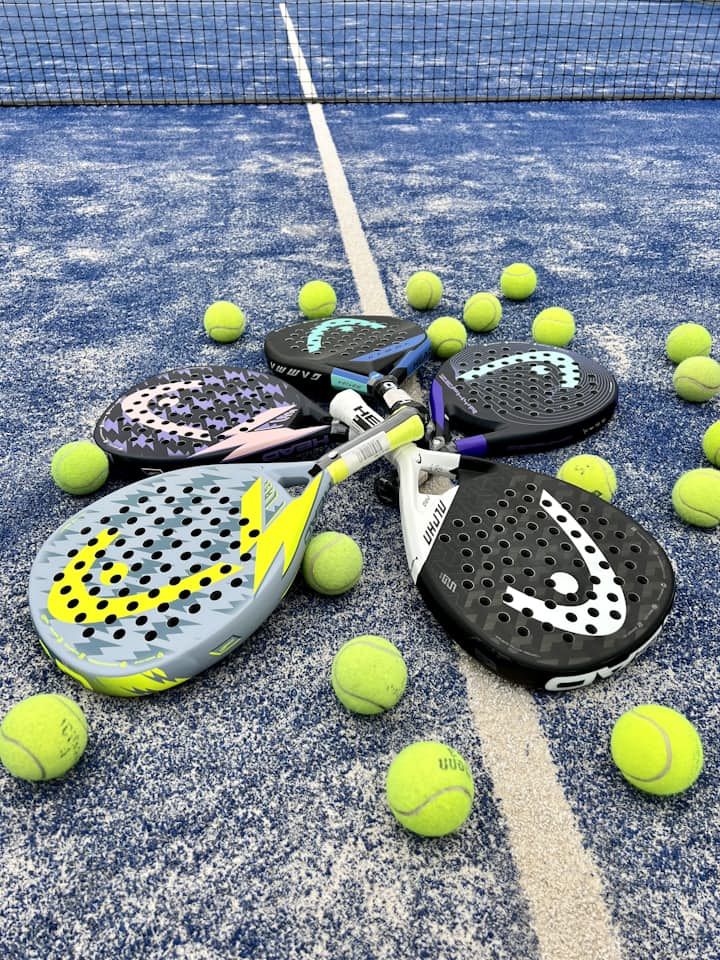
HEAD Radical XL
The HEAD Radical XL is a budget-friendly, lightweight paddle from one of the legacy racquet-sport brands (HEAD also makes tennis racquets used on the ATP tour). It uses a graphite face over an OTC polymer honeycomb core and a 4-inch comfort grip — typical beginner-friendly construction without surprises. HEAD's quality control is consistent in a market where small no-name brands often ship paddles that play differently between units. For someone who wants a recognizable brand without paying $200, this is the steady pick.
Pros
- Established brand with consistent quality control between units
- Larger Dynamic Power Shape gives a forgiving sweet spot
- Comfortable cushion grip that resists hand fatigue in long sessions
Cons
- Edge guard wears noticeably after ~6 months of outdoor play on rough surfaces
- Less spin than raw-carbon paddles (expected at this price; not a deal-breaker for beginners)
Who it's for: Players who want a name-brand paddle and an easy first purchase without researching every spec.
Specs: ~8.0 oz, ~16mm polymer honeycomb core, oversized shape, 4" grip.
Price (Amazon): Check current price on Amazon
JOOLA Essentials
JOOLA is the brand that signs Ben Johns — the world's #1 ranked pickleball player — so it carries genuine credibility on the court. The Essentials is JOOLA's entry-level offering: a reinforced fiberglass surface over a Response Honeycomb Polymer core, a black edge guard, and a White Ridge grip. At 8.2 oz, it sits at the heavier end of the beginner-friendly weight range, which translates to more stability when blocking returns. The 15.5" × 7.9" face with a 12mm core is geared slightly more toward maneuverability than pure forgiveness, but the sweet spot is still generous for a new player.
Pros
- Pro-tier brand reputation, USAPA-approved for tournament play
- Excellent feel transmission — you can tell when you've hit the sweet spot vs. mishit
- White Ridge grip is genuinely comfortable, no need to immediately add overgrip
Cons
- 12mm core is slightly thinner than the 16mm "forgiveness standard" — mishits feel jumpier than on thicker paddles
- 8.2 oz is on the heavier end; players with wrist issues may want lighter
Who it's for: Beginners who already play another racquet sport (tennis, badminton, table tennis) and have the wrist strength to handle a heavier paddle with crisper feel.
Specs: 8.2 oz, 12mm honeycomb polymer core, 15.5" × 7.9" hybrid shape, 4" grip.
Price (Amazon): Check current price on Amazon
Selkirk SLK Halo Control XL
Selkirk is the other "trusted big brand" in pickleball — they sponsor Tyson McGuffin and a deep stable of pros. The SLK line is Selkirk's accessible sub-brand for new and recreational players, and the Halo Control XL is the control-oriented model: a 16mm Rev-Core Control Polymer core, a T700 raw carbon fiber face, and a 5.75" handle that accommodates two-handed backhands. At 7.7–8.0 oz it's a touch lighter than the JOOLA, which most beginners will prefer. The "control" label is honest — this paddle dampens pace, which is exactly what you want when you're still learning to drop the ball softly into the kitchen.
Pros
- 16mm core delivers the most forgiving sweet spot in this list
- Raw carbon face provides real spin grip (unusual at this price point)
- Cushioned faux-leather grip is very comfortable for long sessions
Cons
- The "XL" 16.4" length shifts the sweet spot toward the tip — players coming from a standard-shape paddle will need a session or two to adjust
- Raw carbon face wears slightly over time; expect to need a new paddle after ~12–18 months of heavy outdoor play
Who it's for: Beginners who want to develop control-first habits and don't mind a slightly longer handle for two-handed backhands.
Specs: 7.7–8.0 oz, 16mm Rev-Core polymer core, 16.4" × 7.4" elongated shape, 4.25" grip with 5.75" handle.
Price (Amazon): Check current price on Amazon
Niupipo Pickleball Paddle (Fiberglass)
Niupipo is the budget-friendly outlier on this list. The brand has more than 10,000 Amazon ratings averaging around 4.6 stars, has been Amazon's Choice in the pickleball category for years, and consistently shows up in rec-league bags. The single-paddle model here uses a fiberglass face over a polypropylene honeycomb core, a protective cover is included in the box, and the paddle weighs in the 7.7–8.0 oz range. It is not as polished as the HEAD or JOOLA — the edge guard is a little thinner, the grip a little less premium — but it's USAPA-approved, plays consistently, and costs roughly half what the brand-name picks cost. Don't dismiss it as "cheap" — for someone whose only certainty is that they want to try the sport, this is the rational first purchase.
Pros
- Lowest cost on this list by a wide margin — under $50 in most months
- USAPA-approved, so you can take it into sanctioned beginner tournaments
- Lightweight (7.7 oz) is forgiving on shoulders and wrists for new players
Cons
- Lower-grade materials than premium brands — expect to replace within 12 months of regular outdoor play
- Slightly inconsistent unit-to-unit quality control (a small percentage of Amazon reviews report dead-spot cores out of the box)
Who it's for: Absolute beginners testing the sport for the first time, or players buying a second paddle for a friend who's tagging along.
Specs: 7.7–8.0 oz, polypropylene honeycomb core, fiberglass surface, 4.8" grip.
Price (Amazon): Check current price on Amazon
Onix Z5 Graphite
The Onix Z5 has been in production for over a decade and remains the paddle most pickleball coaches will hand a new student. It's a graphite carbon fiber face over a Nomex honeycomb core — Nomex is older tech than today's polymer cores (it gives a louder, "poppier" sound and slightly less dwell time on the ball) but it's also extraordinarily durable. The Z5's widebody shape (8.125" wide) gives the largest physical hitting surface of any paddle on this list, and the weight comes in at 7.5–8.2 oz depending on the production run. If you want the paddle the most pickleball players in America have actually owned, this is it.
Pros
- Massive widebody sweet spot — the most forgiving shape in this list
- Decade-plus production run means consistent quality and easy replacements
- The Nomex core is famously durable — these paddles outlast their owners' interest in the sport
Cons
- Nomex core is noticeably louder than polymer cores (your neighbors will know you're playing)
- Less "modern feel" than polymer-core paddles; some players coming from newer paddles describe it as "dated"
Who it's for: Beginners who want the proven workhorse — the paddle their pickleball-playing uncle has been using since 2018.
Specs: 7.5–8.2 oz, Nomex honeycomb core, widebody 8.125" face, cushion comfort grip.
Price (Amazon): Check current price on Amazon
How to pick your first paddle
Weight. Aim for 7.6–8.2 oz. Below 7.5 oz the paddle gets twitchy in the hand and you'll mishit more; above 8.4 oz your forearm fatigues after an hour and your shoulder will let you know about it the next morning. Most beginner paddles cluster around 7.8–8.0 oz for a reason. If you have any history of tennis elbow, golfer's elbow, or rotator cuff issues, go to the lighter end (7.6–7.8 oz) — the Niupipo or the lighter Selkirk are good choices.
Grip size. Pickleball paddles come in three common circumferences: 4.0" (small), 4.25" (medium), 4.5" (large). The rough rule is to measure from the bottom crease of your palm to the tip of your ring finger — if it's under 4.25", go small; over 4.5", go large; everyone else, go medium. A grip that's too small causes more wrist injuries than any other equipment problem in pickleball because you over-grip to compensate. When in doubt, size up — you can always add overgrip tape to make a grip thicker, but you can't shave one down.
Shape. Three options matter for beginners: widebody (Onix Z5) is the most forgiving with the largest hitting area; hybrid (HEAD Radical XL, JOOLA Essentials) balances forgiveness with a slightly longer reach; elongated (Selkirk SLK Halo Control XL) trades sweet-spot area for reach and is what experienced players gravitate toward. As a new player you should choose widebody or hybrid for your first paddle — the extra forgiveness compounds across every session you play.
Core thickness. 16mm cores are the forgiveness standard for beginners. 13mm cores trade forgiveness for power and harder shots. 20mm cores (rare, new in 2025) trade even more power for even more control. Pick 16mm for your first paddle. When your dink game gets reliable in 6–12 months and you start wanting more pace on drives, you can experiment with a 13mm or 14mm second paddle. Until then, 16mm.
Budget. The sweet spot is $60–$120. Under $60 the cores often die within weeks of regular play (the honeycomb compresses or the face delaminates). Over $120 you're paying for advanced features — raw carbon faces, thermoformed unibody construction, premium edge foam — that your technique can't yet take advantage of. The $250+ paddles the pros use are designed to perform at the absolute edge of consistency for players who are already consistent; that's the opposite of what a beginner needs. Save the money. When your serve, return, and third-shot drop are all reliable, then look at upgrading to a $200 paddle — and you'll appreciate the difference.
How we picked
We compared the consensus picks across multiple independent pickleball reviewers — Pickleball Effect's beginner buying guide, Pickleball Portal's 2026 beginner rankings, The Slice Pickleball's beginner top-ten, Matt's Pickleball, and BePickleballer's 2026 beginner roundup. We then cross-referenced each candidate against USA Pickleball's approved paddle list (the only paddles you can use in sanctioned tournaments) and against current Amazon availability and review consensus.
We required every pick to meet four conditions: (1) under $120 at typical retail, (2) USA Pickleball approved, (3) available on Amazon with a verified product page (we don't link to vaporware), (4) at least 3 independent review sources rating it as a legitimate beginner pick. We deliberately excluded paddles above $120 — those belong in a different article, and recommending a $250 paddle to someone whose grip is still forming is bad advice no matter how good the paddle is.
We did not test these paddles ourselves. We synthesized public reviews and manufacturer specs. If you want a side-by-side test with high-speed video, those exist on YouTube — but they often disagree on which beginner paddle "wins," precisely because the differences between solid beginner paddles in this price range are smaller than the differences between any two players' swings. The best paddle for a beginner is the one they actually use enough to develop a swing on.
Find local courts to actually play on
A paddle in the closet is just decor. The fastest way to improve is to play 2–3 times a week with players slightly better than you. The Court Scout's directory lists verified pickleball courts in every US state, with real Google ratings, real hours, real surface info, and real cost — no scraping, no pay-to-rank. Find pickleball courts near you to put your new paddle to use.
Sources
- USA Pickleball Approved Paddle List (official equipment certification)
- USA Pickleball Equipment Standards Manual (Jan 2025 PDF)
- Pickleball Effect — Best Pickleball Paddles for Beginners (Expert Buying Guide)
- Pickleball Portal — Best Pickleball Paddles for Beginners 2026: Tested & Ranked
- The Slice Pickleball — Top Ten Best Pickleball Paddles For Beginners (Updated 2026)
- Matt's Pickleball — Best Pickleball Paddles for Beginners (Tested 2026 Guide)
- BePickleballer — 9 Best Pickleball Paddles for Beginners in 2025
- Pickleball Warehouse — Best Pickleball Paddles for Beginners (retailer buying guide)
- The Dink Pickleball — Best Pickleball Paddle for Beginners: Expert Buying Guide
- Pickleball Web — JOOLA vs Selkirk Pickleball Paddles for Control
- WearTesters — Niupipo Pickleball Paddle Set Review
- Onix Pickleball — Z5 Graphite Pickleball Paddle (manufacturer product page)
Have a paddle you'd recommend that didn't make this list? We refresh this article monthly. Email tips to [email protected] — we're always looking for paddles that play above their price.