Why this question lands on so many desks at once
If you sit on an HOA board, run a tennis club, or manage a parks-and-rec facility, there's a good chance someone has already asked you this: can we turn a court (or two, or four) over to pickleball? A large share of the pickleball courts that exist in the US today didn't start as pickleball courts — they started as tennis courts that got restriped, resurfaced, or shared. The geometry is exactly why: a regulation tennis court is 60 ft × 120 ft, a regulation pickleball court is 20 ft × 44 ft, and one fits inside the other with room to spare. That's a gift for anyone trying to add pickleball capacity without buying land.
It's also, increasingly, the source of the most common conflict in community racquet-sports facilities right now — tennis players who feel like they're losing their courts, pickleball players who feel squeezed onto a fraction of what they need, and boards stuck negotiating between two constituencies who both pay dues. This guide covers the actual construction decisions (how many courts, what kind of lines, what net setup) and the community-management decisions, because in practice you can't separate the two.
If you're building from scratch rather than converting, our companion piece — Pickleball Court Dimensions and How to Build a Home Court — covers the official dimensions, surface options, and cost tiers for a purpose-built court in more construction detail than we'll repeat here.
The geometry: how many pickleball courts fit on one tennis court
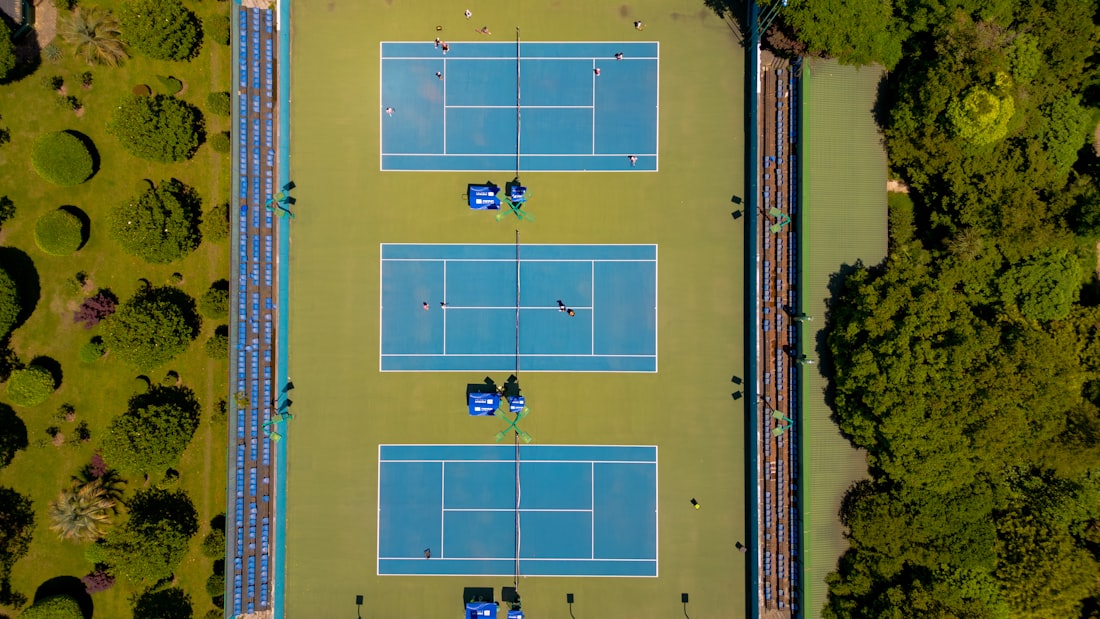
A standard tennis court's 60 ft × 120 ft footprint comfortably contains multiple 20 ft × 44 ft pickleball courts side by side. Court-construction companies who do this work regularly lay out a few standard configurations:
- One tennis court → 4 pickleball courts. The maximum-density, most common conversion for facilities going all-in on pickleball: two courts across each half of the tennis court. Requires full restriping and, for a clean result, separate net posts for each new court rather than reusing the tennis net.
- One tennis court → 2 pickleball courts. A lower-density option chosen when a facility wants wider run-off between courts, or when only partial conversion is planned.
- One tennis court → 1 blended-line court (dual-use). A single pickleball court striped in a contrasting color inside the existing tennis lines, hosting both sports at different times. The cheapest, least disruptive option, and the one most often chosen by HOAs and small clubs that don't want to formally take a court away from tennis — more on the tradeoffs below.
- Multiple tennis courts → proportionally more pickleball courts. Two tennis courts can become four, six, or eight pickleball courts depending on how much run-off and dedicated space you want per court.
Whichever density you pick, the same layout rule from new-court construction still applies: don't cut player run-off to zero just to squeeze in one more court. USA Pickleball's own construction guidance recommends real clearance beyond each baseline and sideline — see our dimensions guide for the specific minimum, recommended, and premium footprint tiers. A four-court conversion that leaves players with no room to chase a lob is a false economy; it saves space on paper and costs you injuries and complaints in practice.
Temporary striping vs. permanent resurfacing
This is the first real fork in the road, and it's as much a political decision as a construction one.
Temporary / overlay striping adds pickleball lines — usually in tape, chalk, or a contrasting paint color — on top of, or alongside, the existing tennis court markings, without altering the surface itself. This is the right starting point when you're not sure how much demand pickleball actually has, when a board lacks authority to permanently alter the court (common for HOAs before a formal vote, or parks departments running a trial before a public hearing), or when you want to preserve full tennis functionality on the same court, sharing it by schedule rather than giving it up.
Tape and chalk are cheap, fast to apply, and just as fast to remove if the trial doesn't work out. The tradeoff is durability — tape wears at high-traffic spots (the kitchen line especially) — and a court with two full sets of lines in different colors is visually busy enough that some players find it genuinely hard to track boundaries mid-rally.
Permanent resurfacing and restriping repairs cracks or low spots, recoats the surface, and paints dedicated pickleball lines as the court's primary (often only) markings — the same acrylic-coating process used for a purpose-built court. This is the right move once demand is established, because it gives players a clean, single-sport surface and, bundled with a broader resurfacing job, extends the life of a tennis court that may already be showing its age. It's also the one-way door: once tennis lines are gone and net posts are pulled, going back to tennis is itself a second construction project, not a repaint.
A middle path worth naming: blended-line dual-use courts, where a single pickleball court is painted in a clearly contrasting color inside the tennis lines and the court formally rotates between both sports on a posted schedule. Done well, this is a genuine compromise — but it depends entirely on both user groups respecting the schedule, which is where a lot of these arrangements break down in practice.
Net height: the fix that's easy to get wrong
Tennis and pickleball nets look similar but aren't the same, and this is the single most common conversion detail that gets missed. A tennis net sits 36 inches high at both the posts and the center. A pickleball net sits 36 inches at the posts but only 34 inches at the center — a 2-inch sag built into the middle of the net that a tennis net doesn't have. Leaving a tennis net at full height across a converted pickleball court isn't a minor technicality: it changes how low players can safely and legally clear a dink, and it will draw complaints from anyone who's played on a properly set pickleball net elsewhere.
There are two ways to solve it. Portable nets — wheeled, freestanding net-and-post units set at pickleball height — are the simplest fix for a multi-court conversion (four dedicated courts just need four separate net setups) and the only realistic option for a blended-line dual-use court, since the net has to come down or change height between sessions anyway. Permanent posts with an adjustable or dual-height system make sense for a dedicated conversion where the tennis posts are being removed anyway: new posts get set at the correct pickleball spacing with a net tensioned to the 36/34-inch spec. Some facilities converting only part of a tennis court install net systems designed to be re-tensioned or swapped between heights, so the same posts serve both sports on a shared schedule — worth asking a court builder about if a blended-line arrangement is the plan.
Either way, don't assume the existing tennis net "is close enough." It isn't, and it's a cheap, fast fix relative to everything else in a conversion project.
The community conflict this genuinely raises — and how it plays out
This is the part of a conversion project that construction guides tend to skip and boards can't afford to. Converting tennis courts to pickleball is, almost everywhere it happens, a zero-sum resource fight dressed up as a facilities decision — and pretending otherwise is how boards end up blindsided.
The access conflict is real and well-documented. In northern Palm Beach County, Florida, several parks converted tennis courts directly to pickleball at scale — Jupiter Community Park turned 3 tennis courts into 8 pickleball courts, Tequesta Park turned 2 into 6, and Kelsey Park in Lake Park turned 2 into 4. Tennis players reported longer waits and having to travel to other parks, with one longtime player summing up the frustration as pickleball "flourishing at the expense of tennis courts." The neighboring city of Palm Beach Gardens took a different approach — leaving its public tennis courts untouched and building new, separate pickleball facilities instead — and Florida's USTA chapter has recommended the same: build dedicated courts rather than convert existing tennis ones, when land and budget allow.
Seattle hit the same conflict from the opposite direction. The city's long-standing practice of "dual-striping" — painting pickleball lines onto existing tennis courts so both sports share the same surface — is being phased out under a new parks department plan, with an immediate loss of dozens of courts pickleball players had been using and a multi-year gap before replacement dedicated courts get built. The backlash came from both directions: pickleball players who didn't want to lose access, and some tennis players who'd made peace with sharing and didn't want the arrangement to end. There's no configuration — full conversion, blended lines, or the status quo — that fully satisfies everyone once both sports compete for the same limited real estate.
Noise is a second, related conflict, specific to conversions near homes. A paddle striking a hard plastic ball produces a sharper, more repetitive sound than a tennis ball off strings. In Scottsdale, Arizona, an HOA converted a tennis court to two pickleball courts without first consulting nearby homeowners; the courts sat roughly 65 feet from the closest homes, well under acoustic consultants' typical recommended buffer, and the dispute escalated through a rejected $140,000 sound-wall proposal, ineffective hours restrictions, and toward litigation. Boise, Idaho saw a similar pattern: some converted courts there were slated to be converted back to tennis specifically because of a noise lawsuit. If your site sits within a few hundred feet of residential property, treat acoustics as part of the conversion decision, not an afterthought.
What actually reduces friction, based on how these cases played out:
- Consult both user groups before construction, not after. Every conflict above escalated fastest where residents or existing tennis players found out only once paint or posts were already down. A posted trial period with temporary striping gives you real usage data and a chance to hear objections while it's still reversible.
- Consider a phased or partial conversion rather than an all-or-nothing swap, especially at a facility with only one or two tennis courts — leaving one for tennis avoids the "we lost everything" framing behind the Palm Beach County pushback.
- Treat noise as a siting question, separate from the court-count question. If a facility has multiple possible conversion sites, the one farthest from residential property is usually the right one to convert first.
- Put any shared schedule in writing and enforce it. Goodwill compromises fail specifically when one group feels the other isn't honoring the agreed split — exactly the dynamic behind most of the disputes above.
None of this makes the conflict disappear. It does mean a board that plans for it up front generally fares better than one that treats the construction as the whole project.
Cost tiers, in qualitative terms
Exact conversion pricing depends heavily on region, contractor rates, and the condition of the existing surface — so think in tiers rather than trusting any single number you see quoted online:
- Lowest tier — temporary tape or chalk striping on an existing, structurally sound tennis court, using portable nets. Close to the cost of materials alone; the standard way to run a low-risk trial.
- Low-mid tier — permanent paint striping on an existing court that doesn't need resurfacing, still using portable nets. A step up in durability over tape, without a full resurfacing project.
- Mid-high tier — full resurfacing (crack repair, recoat) plus permanent pickleball striping, typically bundled with new net posts. Most "dedicated conversion" projects land here, scaling with court count and how much surface repair is needed.
- Top tier — multi-court conversion (a full tennis court to four dedicated pickleball courts) with new fencing, lighting, and acoustic mitigation near residential property. Comparable in scope and cost to new dedicated construction; weight community-conflict planning as heavily as the construction budget here.
Get quotes from a contractor who has specifically done tennis-to-pickleball conversions before, not just general resurfacing — getting net post placement and the dual-line layout right the first time avoids an expensive redo.
Putting it together
Start with the honest version of the question: is this a trial, or a commitment? A trial calls for temporary striping, portable nets, and a posted evaluation period — cheap, reversible, and low-risk politically. A commitment calls for permanent resurfacing, dedicated net posts, and a real conversation with both user groups and any nearby neighbors before a single line goes down. Whichever you choose, get the net height right — 36 inches at the posts, 34 at the center, not a flat 36 — and don't sacrifice player run-off just to fit one more court onto the surface.
If you're weighing conversion against building new courts on separate land, our pickleball court dimensions and DIY build guide covers the official footprint, surface, and net options for ground-up construction. And once your courts are open, The Court Scout maintains a verified directory of pickleball courts across the US — every venue confirmed against a primary source, with real Google ratings — a good place to list a new or converted facility so players nearby can find it.
Sources
- USA Pickleball — Pickleball Court Construction, Lighting and Shading
- USA Pickleball — Court Buildout
- PickleTile — Tennis Court to Pickleball Court Conversion: Layout Configurations for 1–4 Courts
- CourtMaster Sports — Converting a Tennis Court to Pickleball: What It Takes
- FlooringInc — Tennis to Pickleball Court Conversion Guide
- AOL/local news — Wave of pickleball court conversions frustrate northern Palm Beach County tennis players
- KING 5 News — New plan to separate Seattle's pickleball and tennis courts draws backlash from players
- WBTV — Addition of pickleball courts pits neighbor against neighbor, leads to lawsuits
- KTVB — Pickleball courts being converted back to tennis over noise lawsuit