Knowing the serve rule and hitting a good serve are two different skills
Most beginners learn the legal serve in about five minutes: underhand, below the waist, paddle head below the wrist, into the diagonal box. That part is easy — it's a low motion with a small margin for error on the "is this legal" question. What takes longer is turning that legal motion into a serve that actually does something for you: one that lands deep enough to push your opponent off the baseline, doesn't sit up for an easy return, and doesn't get called back on a technicality because your mechanics drift under pressure.
This guide is about that second part — technique, not rules. For the full legal breakdown (contact height, paddle position, the "clearly" standard added in the 2026 rulebook, the fact that a let serve is now just a live ball), see our pickleball rules guide. Here we're covering how to build a serve worth having: grip and stance, the drive serve versus the soft and spin serve, the three mechanical mistakes that wreck most beginner serves, a practice progression, and why rec players and competitive players often serve differently on purpose.
The legal serve, briefly
Two quick recap points worth having in your head before the technique section, because they shape every mechanical choice below:
- You get one serve attempt. There's no second serve in pickleball, so the entire technique conversation below is really about consistency under a one-shot constraint — not about maximizing power the way you might on a tennis first serve, where a miss just costs you a second try.
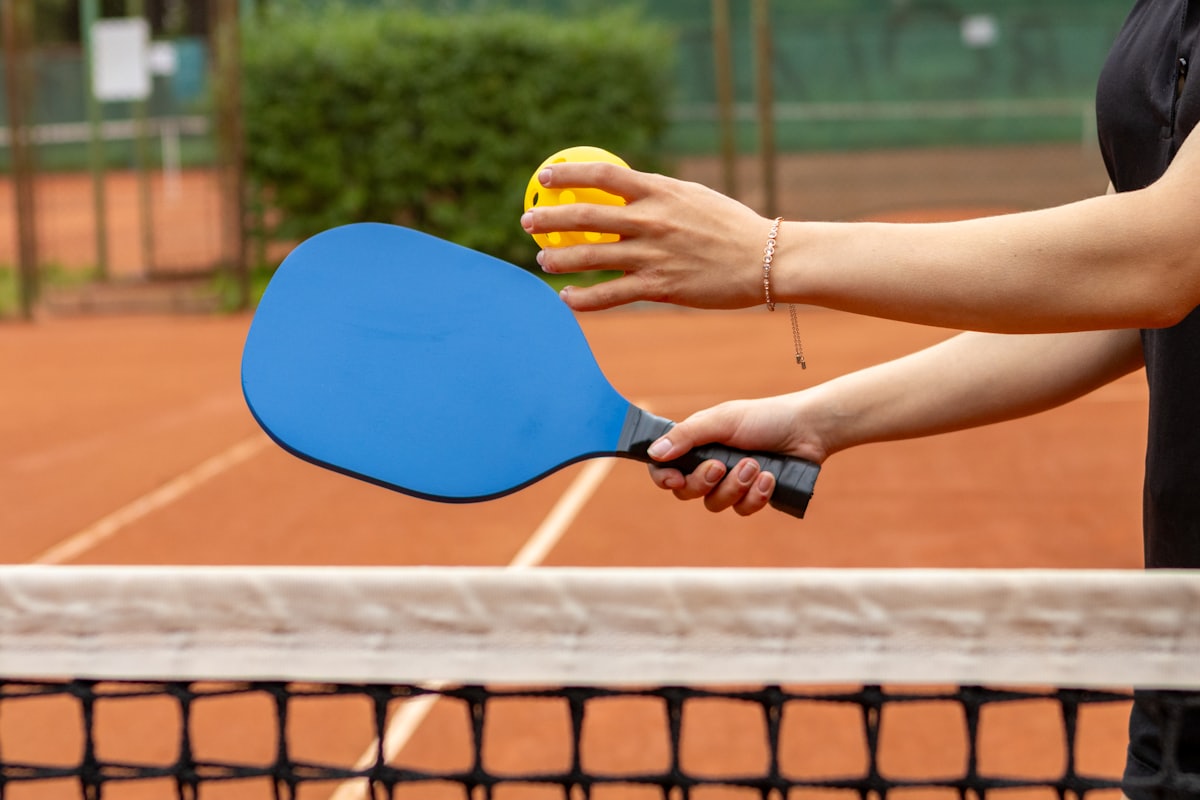
- You can serve two legal ways: a volley serve (drop the ball from your hand and strike it out of the air before it bounces) or a drop serve (let the ball bounce once and strike it on the way up). The volley serve is far more common because it gives a higher, more controllable contact point and more room to generate pace or spin. The drop serve trades some of that control for one advantage — because you're not required to strike it cleanly out of the air, it's a legal, popular option for players who struggle with toss consistency.
Everything from here is about what you do with that legal motion.
Grip and stance: the foundation
Use a continental grip — the same grip that handles nearly every other shot in pickleball, including your dinks, volleys, and drives. If you're not sure what that means in your hand, our how to grip a pickleball paddle guide covers it in detail; the short version is that the continental grip lets you generate an upward, angled paddle face naturally, which is exactly the motion the legal serve requires. An eastern forehand grip (the "shake hands, rotate slightly" grip a lot of beginners default to from tennis or racquetball habits) makes it harder to keep the paddle face open through a clean low-to-high arc and is a common reason beginners round-house their serve into something closer to sidearm.
Stance basics that hold up regardless of which serve you're hitting:
- Feet roughly shoulder-width apart, weight balanced, standing anywhere behind the baseline between the center line and sideline — the legal serving area. A lot of beginners crowd the center line out of habit; you have the full width of your box, and standing closer to your intended target side can help disguise placement (more on that below).
- Non-paddle side foot slightly forward, so your hips and shoulders can rotate through contact instead of staying square to the net. A completely square stance limits how much body weight you can transfer into the shot, which is part of why some beginner serves feel "armsy" and short.
- Toss or drop with your non-paddle hand, out and slightly in front of your body on your paddle side — not straight down at your feet, and not tossed high like a tennis serve. USA Pickleball's own coaching guidance is specific here: for a volley serve, lift the ball slightly before release rather than dropping it from a static hold; for a drop serve, release from a comfortable height just in front of your body, which gives the most predictable bounce and timing.
- Swing from the shoulder, not the wrist or elbow. This is the single piece of advice that shows up across nearly every credible coaching source on the serve: think of the swing as a pendulum motion from the shoulder, finishing all the way through the ball rather than flicking at it. A wristy, elbow-driven serve is inconsistent by nature because it relies on a joint with a much smaller, harder-to-repeat range of motion.
The drive serve: the default competitive weapon
The drive serve is a flat, low-arcing, high-pace serve aimed deep — usually within two or three feet of the baseline — with the goal of pushing your opponent as far back as possible before the point even starts. It's the foundational serve every player should build first, and for good reason: depth is worth more than power. A serve that lands short and hard is a gift; a serve that lands deep, even at moderate pace, delays your opponent's ability to reach the kitchen line and buys you time to control the first few shots of the rally.
Two practical notes: aim at the backhand — targeting your opponent's backhand corner rather than the middle or forehand is a near-universal coaching recommendation, because most players' backhand return is measurably weaker and more likely to sit up short — and depth beats pace. A moderate-speed serve landing two feet inside the baseline is more effective than a hard, flat serve landing mid-court, because the deep serve does the actual job (delaying your opponent's court position) regardless of how fast it got there. Beginners chasing pace on the drive serve tend to sacrifice the consistency that makes the serve worth hitting at all — remember, you don't get a second attempt.
The soft serve and spin serve: trading pace for disruption
Where the drive serve wins through depth and pace, the soft serve and spin serve win by making the ball behave in a way your opponent doesn't expect.
Spin serves are legal as long as the spin is imparted with the paddle at the moment of contact — worth knowing precisely, because USA Pickleball closed a loophole in 2023 that had briefly let servers pre-spin the ball by hand before striking it. That "hand-spin" version is now illegal; spin generated by your paddle swing through the ball is completely legal and is how every legitimate spin serve is hit. Two spin types show up most:
- Topspin, generated by swinging up and slightly across the ball (roughly a 45-degree path rather than straight up), makes the ball dip and kick up higher on the bounce. It's the more broadly useful spin because it works on any surface and tends to push the returner's contact point up and out of their comfortable strike zone.
- Slice/underspin keeps the ball low and skidding after the bounce, and can pull a returner wide or jam them on the backhand. It's generally treated as an occasional change-of-pace option rather than a primary serve, because a low, skidding ball gets easier to handle once a returner has seen it a few times.
Worth knowing: in 2024, USA Pickleball also added rules restricting rough or textured paddle surfaces, specifically because some paddles were being manufactured (or altered) to generate exaggerated spin from surface friction alone rather than swing technique. Legal paddles today can't rely on surface roughness to manufacture spin for you — the spin has to come from the swing.
A true soft serve — a slower, arcing serve, sometimes hit with backspin, aimed short but still clearing the kitchen legally — is a rarer, situational tool. It's mostly used to throw off a returner's timing rhythm after a string of hard, deep drives, the same logic as a changeup in baseball. It's not a serve to build your whole game around, but it's worth having once your drive serve is reliable, since predictability is exactly what good returners exploit.
Three mistakes that get beginners' serves called back (or just returned easily)
Popping the ball up. Usually a symptom of too much wrist or elbow involvement late in the swing — a last-second flick or roll that lifts the paddle face open right at contact. The fix is mechanical: a stable, shoulder-driven pendulum swing with a full follow-through, not a flick. If your serves consistently balloon up and land soft mid-court instead of driving through to depth, this is almost always the cause.
Inconsistent toss or drop. Because you only get one attempt, a toss that varies in height or position means your timing has to re-solve itself every time — exactly the kind of variability that produces both faults (contact too high, paddle head above the wrist) and mis-hits. Fix this before anything else; a repeatable release, from the same spot relative to your body every time, is worth more than any amount of extra swing power.
Telegraphing your placement. Squaring your shoulders, feet, or eyes toward your target before you swing gives an experienced returner a head start on your direction — enough time to load their return early and erase the advantage a good serve is supposed to buy you. Keep your stance consistent regardless of where you're aiming, and pick your target mentally before you step into the motion rather than visibly aiming with your body.
A beginner progression: how to build a reliable serve
If you're starting from nothing, work through this roughly in order — each stage should feel boring-consistent before you move to the next one:
- Shadow swings, no ball. Groove the shoulder-driven pendulum motion and a consistent toss/drop release point without worrying about where the ball goes yet.
- Serve into an empty court, no target, no opponent. Just get 20 in a row landing inbounds, legally, without a fault. Consistency first, everything else later.
- Add a depth target. The "basket of balls" drill works well here: serve 25+ balls to each side, tracking how many land within two or three feet of the baseline, and don't move on until most of them do.
- Add a directional target. Once depth is reliable, alternate between the backhand corner and the middle, without telegraphing which one you're about to hit.
- Add pace, then spin, last. Only once steps 1–4 are boring and automatic should you push for more pace or experiment with topspin. Adding spin or power before your mechanics are consistent just stacks a second unreliable variable on the first.
Rec play vs. competitive play: why the serve strategy actually differs
At most rec and open-play sessions, the serve's job is simple: don't miss it, and make it at least moderately inconvenient to return. Because return quality varies enormously at the rec level, a consistent, moderately deep serve to the backhand is usually enough to create an advantage — most returners aren't punishing a predictable serve yet. Missing the serve is the biggest unforced error a rec player can make, since it's a free side-out with zero contest, so consistency dominates the decision almost entirely.
Competitive play flips the calculus. Once every returner can drive a flat, predictable serve back deep and hard almost automatically, a plain drive serve stops being an advantage — it just starts the rally on even terms. That's the real reason spin serves show up so much more at the pro and tournament level: a well-disguised topspin or slice serve disrupts a skilled returner's timing and contact point just enough to produce a slightly shorter or weaker return, which is often all a strong serving team needs to win the third-shot exchange. Competitive players also vary placement and pace far more deliberately than rec players do, because a good returner adapts to a predictable pattern within a handful of points — the same logic behind mixing pitch types in baseball. None of this changes the legal serve mechanics; it changes what you're trying to accomplish with them once your opponent is good enough to punish a serve that doesn't ask any real questions.
Where to go next
Once your serve is reliable, the next skill that compounds fastest is what happens on the other side of the ball — the return of serve, positioning at the kitchen line, and the third-shot drop that decides who controls the point. Our pickleball strategy basics guide covers all three. And if your serve motion still feels inconsistent because your grip isn't quite right, start with our how to grip a pickleball paddle guide — it's a five-minute fix that solves more serve problems than people expect.
Sources
This guide is written and fact-checked against official USA Pickleball coaching content and instructional material from established pickleball coaching outlets, consistent with the legal serve mechanics laid out in our own pickleball rules guide:
- USA Pickleball — Top 7 Pickleball Serve Tips to Improve Your Game
- USA Pickleball — Official Rulebook (current edition, PDF)
- USA Pickleball — Equipment Standards Manual (paddle surface rules, 2025)
- The Dink Pickleball — Pickleball Serving Strategy: Spin, Speed & Depth Tips
- The Dink Pickleball — 7 Pickleball Mistakes Beginners Make Without Realizing
Ready to put this serve to work? The Court Scout maintains a verified directory of pickleball courts across the US — every venue confirmed against a primary source, with real Google ratings, real hours, and honest cost info. Find courts near you and get some reps in.