The whole rulebook, one screen
This is a lookup card, not an explainer. Need the why behind any of these — how the wall rule actually plays out, what the 2026 deuce-format change means, when a serve that clips the mesh is a fault — read the full padel rules guide. Everything below is sourced from the same place that guide is: the FIP Rules of Padel, maintained by the International Padel Federation (FIP), the sport's global governing body.
Court & net dimensions
| Spec | Measurement |
|---|---|
| Court size | 10 m wide × 20 m long (inside measurement), doubles only |
| Service line distance from net | 6.95 m on each side |
| Service boxes | Each side split left/right by a center service line, mirroring tennis |
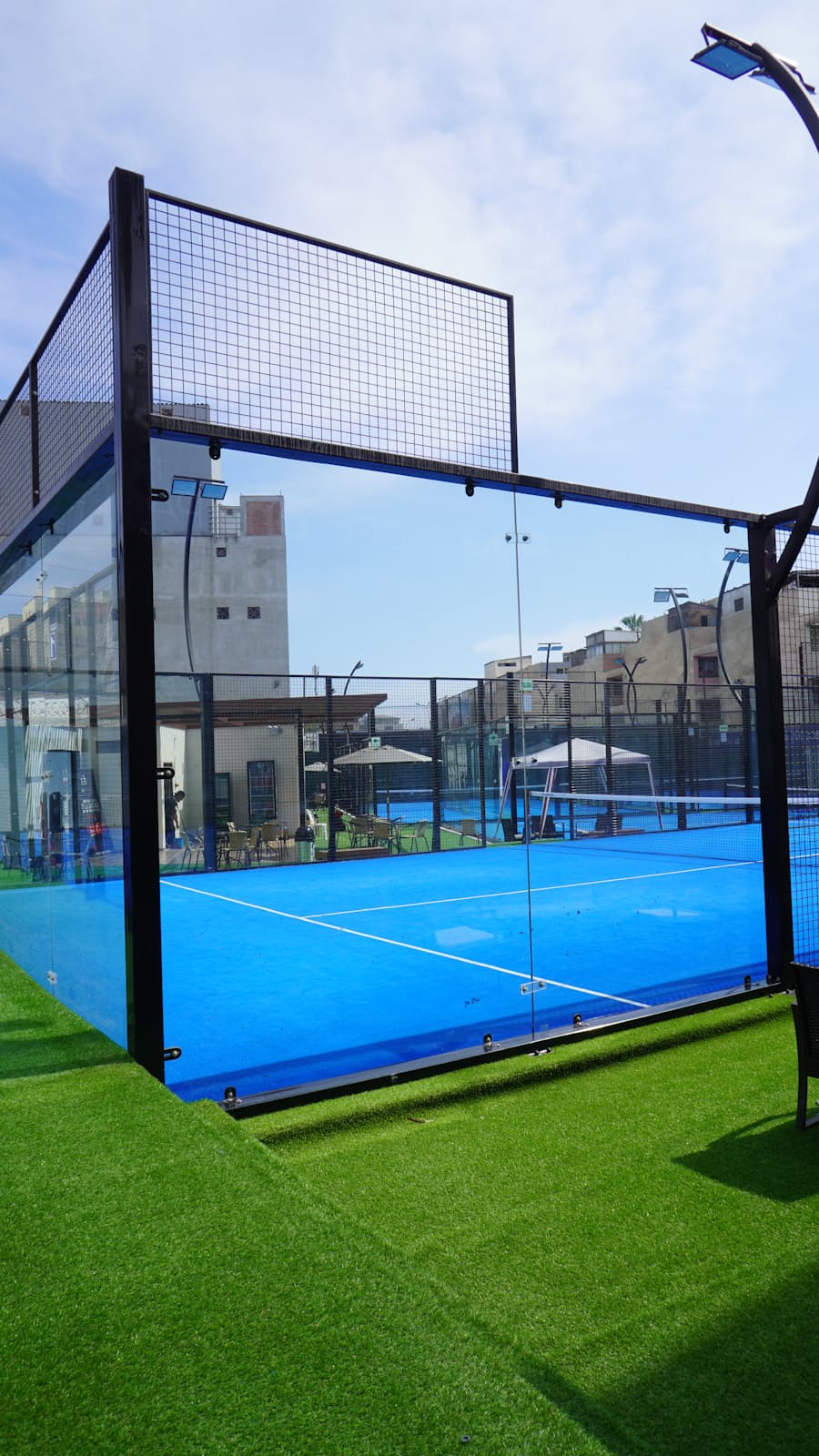
| End-wall (behind baseline) height | Up to 3 m solid wall (glass, brick, or hard uniform-bounce material) + 1 m mesh above = 4 m total enclosed height |
| Side walls | Either stepped 3 m + 2 m wall sections with mesh filling the rest, or a full 3 m × 4 m glass section at each end with mesh completing the rest |
| Net height | 0.88 m at the center, 0.92 m at the posts |
| Playing surface | Typically artificial turf with sand infill; cement/other synthetic surfaces also permitted |
| Racket | Short, solid, perforated paddle, no strings, max 45.5 cm total length |
| Ball | Rubber, similar size to a tennis ball, lower internal pressure |
Scoring at a glance
| Level | Rule |
|---|---|
| Points in a game | 15 → 30 → 40 → game, win by 2 points |
| Games in a set | First to 6 games wins, win by 2; 5–5 goes to 7–5; 6–6 triggers a tiebreak to 7 points (win by 2), setting the score at 7–6 |
| Sets in a match | Best of 3 sets |
| Deuce (40–40) | One of three official formats, agreed before the match starts (see below) |
Assume traditional advantage scoring at deuce unless told otherwise — most US recreational clubs still play it, even though FIP added two faster options for 2026.
Deuce format options (effective January 1, 2026)
- Advantage (traditional). Win a point at deuce for "advantage"; win the next point too to take the game. Lose it and it's back to deuce — can repeat indefinitely.
- Star Point (new for 2026). Up to two rounds of advantage; still tied after that, one sudden-death point decides it. The receiving pair picks their receiving side and can't switch at the last second. Default on the Premier Padel tour going forward.
- Golden Point. No advantage at all — the receiving pair picks their side, next point wins the game outright. Fastest option.
Serve rules
- Underhand only, contact at or below waist height. No overhand serve, ever.
- Ball must bounce first. Drop and bounce it — no serving off a toss like tennis.
- Served diagonally from behind the service line, one foot behind the line, into the diagonally opposite service box. First serve of a game goes to the receiver's left box, then alternates right/left after each point won.
- Two attempts, like tennis. Miss both and it's a fault; the point goes to the receiving pair.
- Can't touch the mesh before its second bounce. A serve that lands correctly and then clips the metal mesh fence before bouncing again is a fault — even though the identical shot mid-rally would be legal. Clipping the back glass after a correct bounce is fine.
- Service alternates between partners each game; the receiving order set for a game holds through that game.
- Net serves that land correctly are replayed ("let"), same as tennis.
The wall rule, in one line each
- Core rule: once the ball bounces on the ground on your side, it stays live no matter what it hits next (glass, mesh, corner) — as long as you return it before a second bounce.
- Fault: ball hits a wall or mesh before bouncing on your side — point lost immediately, no wall play allowed.
- Fault: ball bounces twice on your side before you return it.
- Fault: your return clears the mesh and exits the enclosure at a court with no certified out-of-court safety zone.
- Legal (advanced): a shot that bounces off your own back wall first, without touching the ground again, and then clears the net — a valid return, not a foul.
- Court-dependent: some facilities have a certified safety zone (FIP Rule 16) letting play continue on a ball that legitimately exits through a side gate or over the fencing; many clubs, especially older or tightly packed indoor setups, don't have that clearance. Ask before assuming you can chase a ball outside the cage.
Format
- Doubles only. FIP's rulebook — dimensions, scoring, serve order — is written entirely for pairs. There is no meaningful competitive singles padel; Premier Padel is exclusively doubles.
- You need four players (or a club drop-in/"americano" session) to play — you generally can't show up solo and expect to fill in the way you might at open-play pickleball.
Common faults — quick list
- Volleying the return of serve — the return must bounce first, just like the serve itself.
- Playing the wall before the bounce — instinctively intercepting a ball heading for the back wall instead of letting it bounce first.
- Foot faults on serve — stepping on/over the service line, or crossing the center-line extension before contact.
- Serving overhand out of muscle memory — common among tennis players in their first sessions.
- Assuming the mesh behaves like the glass on serve — a serve that clips the mesh before its second bounce is a fault, unlike the same contact mid-rally.
- Not knowing whether the court allows out-of-court play — chasing a ball through a gate on a court without the safety clearance is a rules and safety issue; ask first.
FAQ
What's the padel wall rule in one sentence? Once the ball has bounced on your side, it stays in play through any wall or mesh contact until you return it — but the ball must bounce on the ground before touching a wall, or it's a fault.
How is padel scoring different from tennis? It isn't, structurally — same 15/30/40/game, six-game sets, best-of-three-sets skeleton. The only difference is what happens at deuce: as of 2026, matches can use traditional advantage, the new Star Point sudden-death format, or Golden Point, chosen before play starts.
How many serve attempts do you get in padel? Two, same as tennis. Miss both and the point goes to the receiving pair.
Can you volley a padel serve? No — the return of serve must bounce first, exactly like the serve itself. Volleying it is a fault.
Is padel ever played as singles? Not competitively. FIP's entire rulebook is written for doubles, and the professional Premier Padel tour is doubles-only.
Why does a serve that clips the mesh count as a fault but a rally shot doesn't? It's a padel-specific serve restriction (FIP Rule 6): a serve that lands correctly in the box is still a fault if it touches the mesh fence before its second bounce, even though touching the mesh is completely normal and legal during a rally.
Full explainer
For the reasoning behind each rule, the court construction details, and how the 2026 deuce-format change plays out in practice, see the complete padel rules guide.
Sources
- International Padel Federation (FIP) — Rules of Padel, revision effective 01.01.2026 (PDF)
- International Padel Federation (FIP) — official site
- The Court Scout — padel rules guide
Know the rules — now find a court. The Court Scout maintains a verified directory of padel venues, every venue confirmed against a primary source, with real Google ratings and honest details. Find padel courts near you.