This is the sequel, not the intro
Our main padel rules guide covers the wall rule at the level a new player needs: the ball has to bounce on the ground first, and after that it can bounce off any wall or the mesh fence and still be alive, as long as you return it before a second bounce. That's correct, and it's 90% of what you'll ever need on court.
This piece is for the other 10%: what actually happens if the ball hits the wire mesh above the glass instead of the glass itself? What if it goes over the fence into the next court? What if it hits the net post? We went back to the source rather than guess: the FIP Rules of Padel (International Padel Federation, revision effective 01.01.2026), rule by rule. Where the rulebook is genuinely ambiguous or silent, we say so instead of filling the gap with a confident-sounding guess.
One caveat up front: FIP's rules are written for regulated, homologated courts — built to spec for competition. Plenty of casual and converted courts, especially older indoor facilities in the US, don't meet every construction detail in the rulebook (more on why that matters below, in the out-of-court section). Club house rules can and do fill gaps the official rulebook leaves to court design.
The mesh is legally "the wall" — including the ledge on top
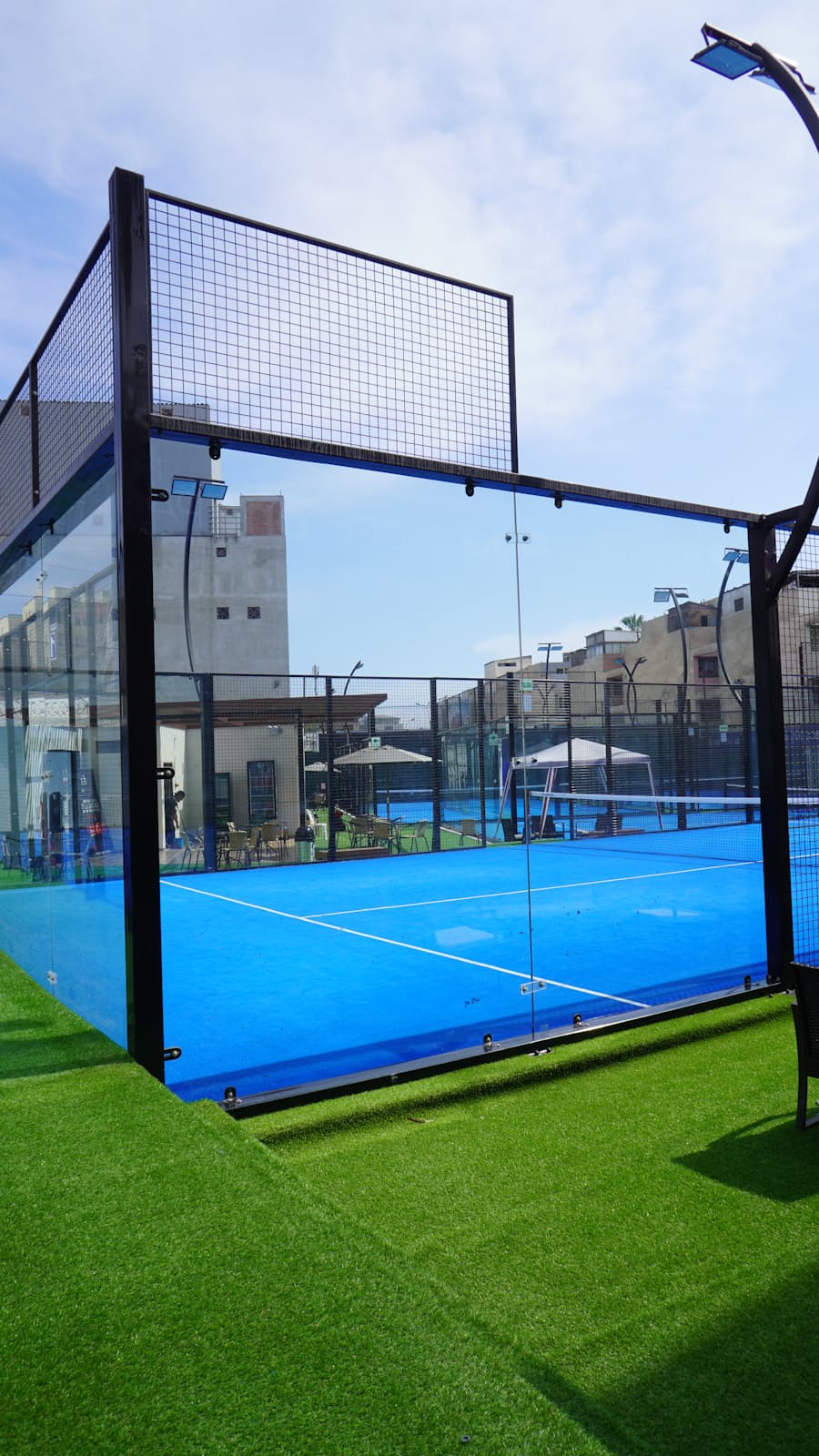
The clearest thing to verify first: does the wire mesh above the glass behave any differently than the glass itself once the ball is live? No. FIP Rule 12.4 defines "parts of the court" for the in-play rule as "the insides of the walls, the metallic mesh fence that encloses the court, the ground, the net and net posts. The mesh and frame in its entirety will be considered as part of the fence." So once the ball has bounced on the ground on a side, it can carom off the glass, the mesh above the glass, the frame holding the mesh, a corner where two of those meet, or any combination, and it's still in play — no different treatment for mesh versus glass.
Where it gets genuinely interesting is what happens when the mesh isn't a clean surface. FIP Rule 15 lists two ways a rally ends in a win for the team that hit the ball, both involving the fence's imperfections: if, after bouncing correctly in the opponent's court, the ball goes out through an actual hole in the metal mesh, or gets stuck in that hole, the hitting team wins the point outright. Same outcome if the ball gets stuck on the flat horizontal ledge that runs along the top of the wall, where the solid wall meets the mesh. Both are codified rules, not house calls improvised on the spot. If you've ever seen a ball wedge itself into a worn patch of mesh at a well-loved club court, that's not a redo — it's a clean winner for whoever hit it, provided their shot already bounced fair on your side first.
The double bounce is about count, not contact
The rulebook is precise about what actually loses you the point on a return, and it's simpler than it can feel in the moment: Rule 13(c) says the point is lost the instant "the ball bounces for a second time before being returned." Full stop — there's no separate exemption or extra chance if the ball touched a wall or the mesh somewhere between bounce one and bounce two. Touching a wall doesn't "reset" anything and it doesn't buy you a third bounce; it's just part of the ball's path between the two bounces that actually matter.
So: ball bounces once in front of you, you hesitate, it bounces a second time before your racket touches it — fault, regardless of whether a wall was ever involved. Conversely, a ball that bounces once, rockets off the back glass, catches the sidewall mesh, and comes spinning back toward the middle of the court is still perfectly alive, as long as none of that involved a second ground contact. The wall segments in between are irrelevant to the count; only the ground contacts are.
Your shot has to land before it can touch their walls
This is the reverse case, and it trips up players moving from tennis, where hitting a side fence on the fly is simply "out." In padel, the same idea applies to your own shot traveling toward the opponent's side: FIP Rule 13(f) is explicit that if you return the ball — directly or off your own walls — and it reaches the opponent's side without bouncing there first, then hits their wall, their mesh, or anything else on the ground over there, you lose the point. Rule 13(g) extends the same logic to a shot that clips the net or a net post and then flies directly into the opponent's wall or fence without an intervening bounce.
In other words, "bounce first, then wall" isn't just something that protects you defensively — it's a requirement your offense has to satisfy too. A blistering shot that would be an outright winner if it landed flat instead sails long, catches the back glass on your opponent's side without touching the ground first, and it's your point lost, even though the ball never left the enclosure.
Net post vs. door post — two different posts, two different rules
Worth separating carefully — the rulebook covers two structurally different posts and treats them differently, and it's an easy pair to conflate.
The net post is the post holding up the net at the center of the court, same as in tennis. What happens when the ball touches it depends entirely on when in the point it happens:
- On a serve, FIP Rule 9.1(a) classifies a serve that touches the net or the net post and still lands correctly in the receiver's box as a "net" — grouped under the rule titled "Repeat or 'Let' and 'Net' Serve," meaning it's replayed, exactly like a tennis let. (The one exception, per the same clause: if that serve then touches the mesh fence before its second bounce, it's a fault instead — the net-cord grace doesn't extend that far.)
- During a rally, it's a completely different outcome. FIP Rule 14(e) lists "the ball touches to the net or net posts, and then lands in the opponent's court" as a correct return — a live ball, full stop, with no replay. There's no rally-time "let" for touching the net post the way there is on serve; if it clips the post and still drops in, play continues exactly as if it had cleared cleanly.
- Separately, if a player — their racket, or anything they're wearing — touches the net or net post while the ball is still in play, that's a lost point under Rule 13(a), regardless of what the ball itself did. That's a player-contact fault, not a ball-contact rule, easy to confuse with the two above.
The door post is different hardware entirely: the vertical post dividing the access gates between two adjoining courts, relevant only at facilities set up for authorized out-of-court play (covered next). FIP Rule 13(b) designates the portion of that post above 0.92 meters as a neutral zone any of the four players may touch or hold without penalty while chasing a ball outside the enclosure. It has nothing to do with the net.
When the ball leaves the court entirely
This section has the most real-world variation, because — unlike the wall and net rules — whether any of it applies depends on how a specific court is built.
The baseline rule, with no special court features: if a shot that has already bounced correctly then flies out of the enclosure — over the mesh, through a gate — FIP Rule 13(d) treats that as a lost point the moment it happens, unless the facility is specifically built and certified for "authorized out-of-court play."
What "authorized out-of-court play" actually requires, per the FIP court specification, is not a formality: each side of the court needs two access points, a clear buffer zone outside the enclosure at least 3 meters wide (4 recommended) by 4 meters long by 3 meters high, and the gate structure has to be padded against player contact. Most competition-grade padel facilities are built to this spec; a lot of casual, retrofitted, or space-constrained indoor courts — especially where courts are packed close together — simply aren't, which is exactly why asking the front desk before you assume you can chase a ball through a gate still matters, as our intro guide notes.
A wrinkle we hadn't previously covered: even at a court built for authorized out-of-court play, treatment differs by direction. Per FIP Rule 13(e), a ball that goes out over the end wall (behind a baseline) after bouncing correctly is a lost point — full stop, no chase, regardless of whether out-of-court play is otherwise authorized there. A ball that goes out over a sidewall or through a door, by contrast, stays alive: the point isn't lost until it bounces a second time or touches something unrelated to the court, so a player can genuinely step outside through the gate and play it back before either of those happens. The chase mechanism is a side-and-door feature, not an end-wall one.
On a ball flying in from a neighboring court, rather than out toward one: the rulebook has no dedicated "invasion from next door" clause, but Rule 10.1(b) covers it directly — a point in dispute is a "let" (replayed) if "any element not part of the game invades the court area." A stray ball rolling in from an adjacent court mid-point reads squarely as that: stop play, call the let, replay the point. We couldn't find anything in the FIP text addressing the other side of that scenario — what happens to the neighboring court's own point when their ball is the one that wanders off — so we're not going to guess at an answer the rulebook doesn't give; in practice that's sorted by mutual agreement between the courts, or by a shared umpire in a tournament setting.
The "bounced, then flew out" sequence, fully resolved
This ties the earlier sections together. Say your return bounces cleanly in the opponent's court — a legal shot by every measure covered above — and then, because of the pace or spin you put on it, it keeps traveling and exits the enclosure entirely without ever touching the ground a second time. Does that undo the legality of your shot?
No. FIP Rule 14(d) directly covers this: a ball that "bounces in the opponent's court and then goes out of court, hits the ceiling, the lights or any other object not related to the court" as a result of the direction and force it was hit with is explicitly listed as a correct return. Your shot did its job the moment it bounced in bounds; everything after that is the receiving side's problem, governed by the out-of-court rules above — not a retroactive fault on the shot that produced it. A wall-then-out sequence is not automatically a fault, precisely because the first bounce already happened on the court. What happens next depends on whether that specific court is built for a chase and which side of the enclosure the ball left through.
What we're confident about, and what we're not
Everything cited above traces to a specific numbered FIP rule, quoted directly rather than paraphrased loosely, because on rules content that's the only way to be trustworthy. Two honest caveats: FIP's published English version reads, in places, like a careful but imperfect translation from the original Spanish (Rule 13(e) in particular is awkwardly worded) — we've paraphrased those sections for clarity while keeping the substantive distinctions the text clearly supports, rather than inventing a cleaner rule than what's written. And the rulebook is silent on the neighboring-court scenario noted above — what happens to a neighboring court's live point when their ball is the one that wanders off — so we flagged that gap instead of asserting an answer.
If your local club plays under different house rules for out-of-court chases, mesh-hole winners, or anything else here, that's not necessarily wrong — FIP governs FIP-sanctioned play, and plenty of recreational venues simplify or skip rules that depend on construction specs their court doesn't have.
Where to go from here
For the full picture — court dimensions, the 2026 deuce-scoring change, serve mechanics, and the wall rule at the level most players actually need day to day — start with our padel rules guide. If you're gearing up rather than just studying the rulebook, the beginner padel guide and best padel rackets guide cover equipment and getting started. And if you want somewhere to test these edge cases against a real mesh fence, The Court Scout maintains a verified directory of padel venues, rebuilt from each club's own primary sources rather than scraped listings.
Sources
- International Padel Federation (FIP) — Rules of Padel, revision effective 01.01.2026 (PDF) — Rules 9–16 and the Court / Safety Area & Out-of-Court Play sections
- International Padel Federation (FIP) — official site
- The Court Scout — Padel Rules Explained: Scoring, Serving, and the Walls
- The Court Scout — beginner padel guide
- The Court Scout — global padel hub