The short answer
Padel and squash are both racquet sports built around a wall that keeps the ball alive — but they're not close cousins the way padel and tennis are. Squash is fast, mostly singles, and played with a strung racket and a dead, barely-bouncing ball inside a room where every surface but the floor and one open end is fair game. Padel is slower-paced, doubles-only in any real competitive sense, played with a solid stringless paddle and a low-pressure ball, on a court roughly twice the footprint of a squash court. A squash player picking up padel will find the wall instincts transfer; a padel player picking up squash will find almost nothing else does.
What actually overlaps
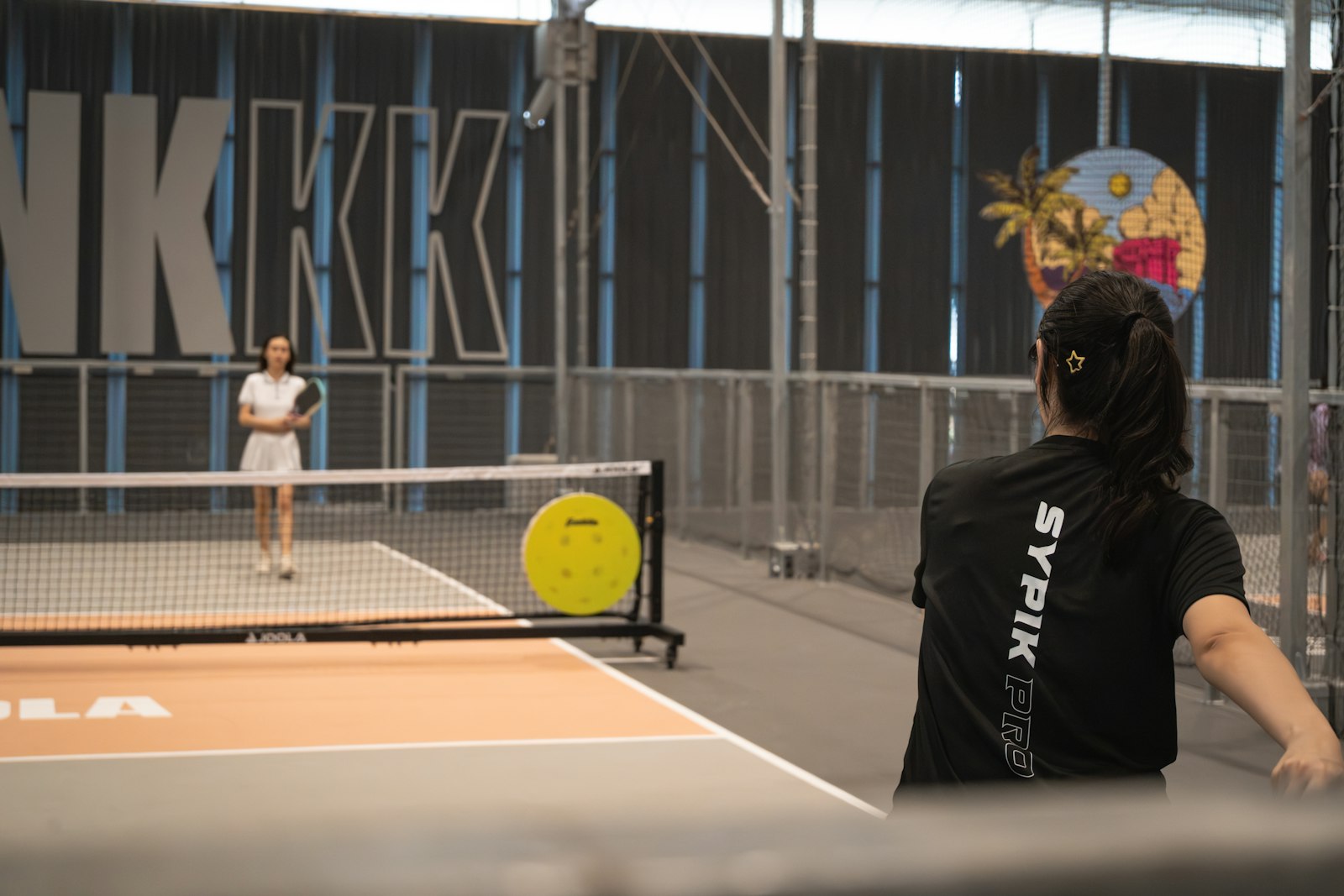
Start with the real similarity, because it's the reason this comparison gets asked in the first place: both sports use the enclosure itself as part of the game, not as a boundary that ends the point. In squash, every rally after the serve is built around hitting the front wall (and legally using the side and back walls along the way) before the ball bounces twice. In padel, per the FIP Rules of Padel, a ball that's already bounced once on your side stays in play off the back glass and mesh fencing, letting you retrieve a shot that would sail out of bounds on an open court. That's a genuinely shared skill: reading how a ball comes off a hard surface, not just tracking a straight flight path the way you would in tennis or pickleball.
That's about where the overlap ends. Everything below — the room you're standing in, how you win a point, what's in your hand, and who else is on court with you — is a real, structural difference, not a stylistic one.
Court construction: a room vs. an open cage
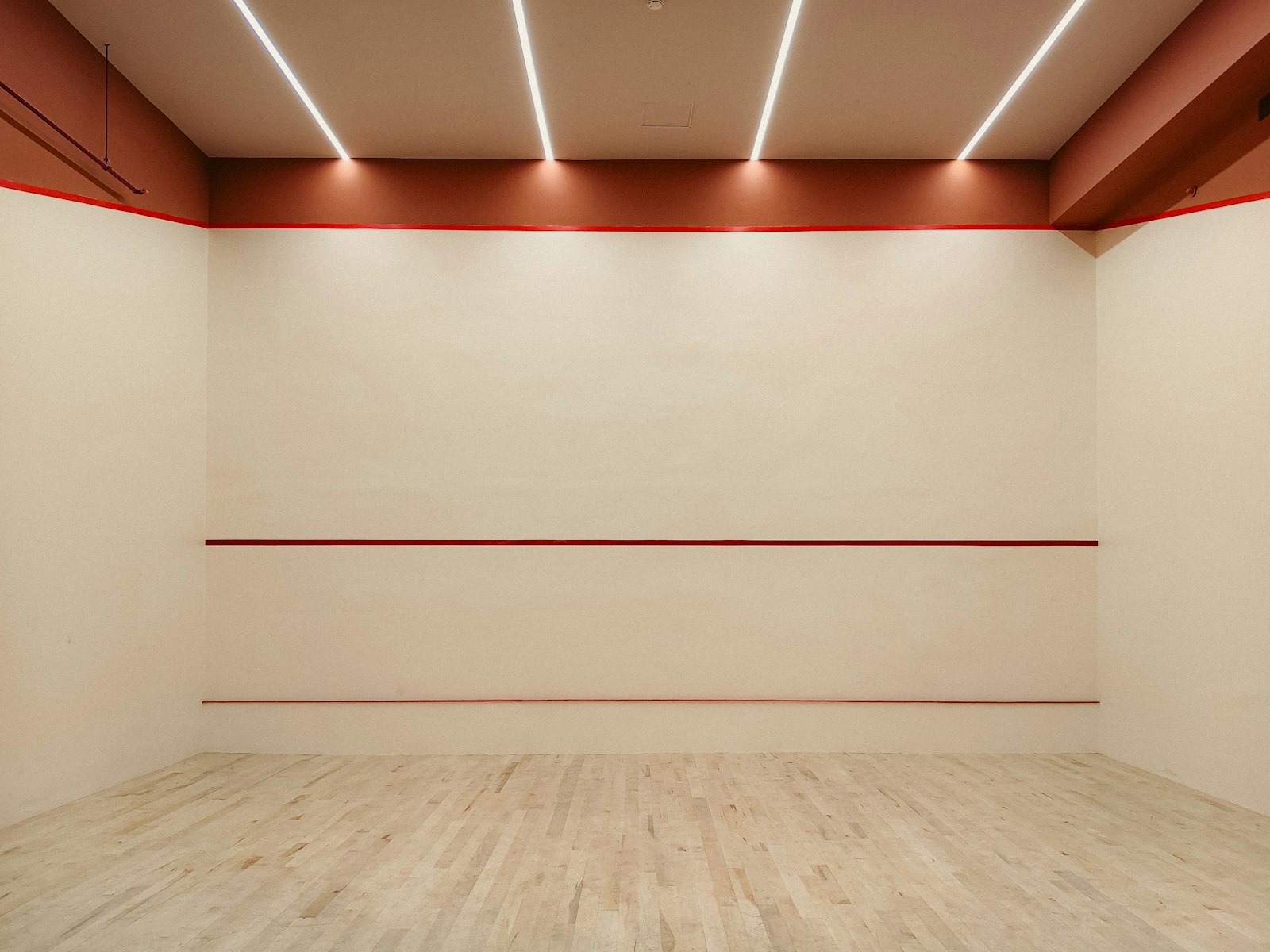
The two sports don't just differ in size. They're built on completely different principles — squash is a fully solid, four-walled room; padel is an open-topped enclosure with glass at the ends and metal mesh along most of the sides.
| Squash (singles court) | Padel | |
|---|---|---|
| Length × width | 9.75 m × 6.4 m | 20 m × 10 m |
| Front/end wall height | 4.57 m (front wall) | 3 m glass + 1 m mesh = 4 m total, ends only |
| Back wall height | 2.13 m | Same as front (glass) |
| Side walls | Solid, floor to ~4.57 m (sloping down to back) | Mix of glass and mesh, roughly 3 m/2 m sections |
| Enclosure | Fully solid on 4 walls, one end open at the top for the gallery | Open top; mesh, not solid, along most of the sides |
| "Out of bounds" line | The tin (480 mm standard club height; 430 mm at pro level) and out-lines painted on the walls | The mesh top rim / enclosure exit, or a certified out-of-court safety zone at some clubs |
| Surface | Wood or a synthetic equivalent | Artificial turf with sand infill (most common); cement/other hard synthetics also permitted |
Sources for the squash figures: the World Squash Federation's official court specifications and its member-facing dimension guidance (cross-checked against US Squash's court-specifications page, which explicitly defers to the WSF standard). Padel figures per FIP, as detailed in our padel rules guide.
The practical read: a squash court is a sealed room roughly the size of a large bedroom, and you can hit almost any surface in it (front wall above the tin, both side walls, the back wall) as part of a legal shot. A padel court is over three times the floor area, open at the top, and only the ends are solid glass — the mesh sides return the ball differently (duller, less predictable) than glass does, and a ball that clears the mesh entirely is usually just gone, not retrievable the way an over-the-back-wall padel shot sometimes is.
Scoring: point-a-rally to 11 vs. tennis's 15-30-40
This is one of the clearest structural differences, and it changes the actual rhythm of a match.
Squash uses PAR — Point-A-Rally scoring. Since the World Squash Federation made PAR the universal standard in 2009, every squash match (recreational or professional) plays games to 11 points, win by 2, with the point going to whoever wins the rally regardless of who served. A match is best of five games. There's no equivalent of tennis's game-within-a-set structure — you're just racing to 11, repeatedly, up to five times.
Padel uses tennis's full point-game-set skeleton. As covered in our padel rules guide, points go 15-30-40-game, games are grouped into sets (first to 6, win by 2), and a match is best of three sets — plus, as of a FIP rules change effective January 1, 2026, tournaments now choose from three official formats for handling deuce (traditional advantage, the new Star Point sudden-death format, or Golden Point). Squash has no deuce concept at all in its PAR format; games just keep going past 10-10 until someone leads by two points, same value each time.
The practical effect: a squash game to 11 is short and can flip fast — a single bad service game doesn't cost you a whole set the way it can in padel's tennis-style scoring, but a squash match's best-of-five format means you need to win three separate short races, not build a cushion across a long set the way padel allows.
Equipment: strung and solid are opposite design philosophies
Squash rackets are strung, capped by WSF equipment rules at 686 mm (27 in) long, 215 mm (8.5 in) wide, with a maximum strung area of 500 cm² and a maximum weight of 255 g (most rackets sit lower, around 90–150 g). It's a genuinely light, whippy tool built for fast wrist snap in tight spaces.
Padel rackets are the opposite: solid and stringless, a foam core between two rigid, perforated faces, capped at 45.5 cm total length under FIP's equipment rules — closer in feel and construction to a pickleball paddle than to anything strung. There's no string tension to think about, no restringing between matches, and a much shorter swing radius, which matters in padel's tighter doubles-court spacing.
The balls are built for opposite goals, too. Squash balls are small (39.5–40.5 mm diameter, 23–25 g) and deliberately low-bounce, and the WSF's dot-color system tunes that further by player level and court temperature: blue dot is fastest/liveliest (used by beginners, since a cold ball needs help staying lively), red dot is medium, single yellow is slow, and double yellow — the ball actually used in professional and advanced play — is the slowest and deadest of the standard specs. Colder courts and stronger players get a deader ball on purpose, because a fast, high-bouncing ball is easier to control, not harder. Padel balls are a low-compression rubber sphere sized close to a tennis ball, with no comparable level-based color system — everyone plays the same standard ball regardless of skill.
Singles culture vs. doubles-only
This is the difference that surprises crossover players the most in either direction.
Squash is fundamentally a singles sport. The World Squash Federation's rulebook, court dimensions, and every major professional tour (the PSA World Tour) are built around one player per side. Doubles squash exists — WSF maintains separate international doubles rules — but it's a genuine minority format, played on a wider court, not the default the way singles is.
Padel is fundamentally a doubles sport, and not in a "doubles is more common" sense — in a "there is essentially no competitive singles format" sense. FIP's entire rulebook is written in terms of pairs, the professional tour (Premier Padel) is exclusively doubles, and walking onto a padel court means you need three other people, not one opponent. If you're used to squash's world — book a court, find one opponent, play — padel's doubles-only culture is the single biggest logistics adjustment, not a rules one: most clubs solve it with drop-in "americano" mixer sessions that pair up solo players, since you can't reliably show up alone the way you can for squash.
What actually transfers if you cross over
From squash to padel: your wall-reading instincts transfer directly — you already understand that a ball coming off a hard surface changes angle predictably once you learn the geometry, which is exactly the skill padel's back-glass rallies reward. What doesn't transfer: the racket (relearning a solid paddle's shorter, punchier swing after years of a strung racket's whip takes real reps), the underhand-only serve (squash's serve has no such restriction), and the doubles spacing and communication with a partner, which a lifelong singles player has simply never had to think about.
From padel to squash: almost nothing physical transfers cleanly. Squash's ball is far livelier and faster than padel's low-compression ball, the room is far smaller and fully enclosed (so every surface, not just the ends, is in play), and singles squash means covering the entire court alone rather than splitting it with a partner — a genuinely higher continuous-movement demand with nobody to share the ground. The strung racket's whippier swing is also a real relearn coming from a solid paddle. Padel players describe squash as feeling "claustrophobic" and relentless on a first session — there's no partner to hand off a wide ball to, and the smaller room means less time to recover between shots.
Where to actually play
Honest disclosure, in the spirit of every comparison piece on this site: The Court Scout's verified directory covers padel (US and international) but does not currently list squash courts — that's a real coverage gap, not a hidden preference, and we'd rather say so plainly than let you assume otherwise. If padel is what you're after, our global padel directory covers verified clubs with real hours, cost info, and Google ratings, and our padel rules guide and beginner padel guide cover everything past this comparison. For squash courts, the World Squash Federation's member-nation directory and your national federation (US Squash, England Squash, etc.) are the right starting points — most dedicated squash clubs also list their own court booking directly on their own site.
Sources
- World Squash Federation — Court Construction & Specifications
- World Squash Federation — Rules of Squash
- World Squash Federation — Racket Specifications
- World Squash Federation — Ball Specifications
- World Squash Federation — Full Members
- US Squash — Court Specifications
- International Padel Federation (FIP) — Rules of Padel (PDF)
- The Court Scout — Padel Rules Explained
- The Court Scout — Beginner Padel Guide
- The Court Scout — global padel directory