Same net, same lines, different sport
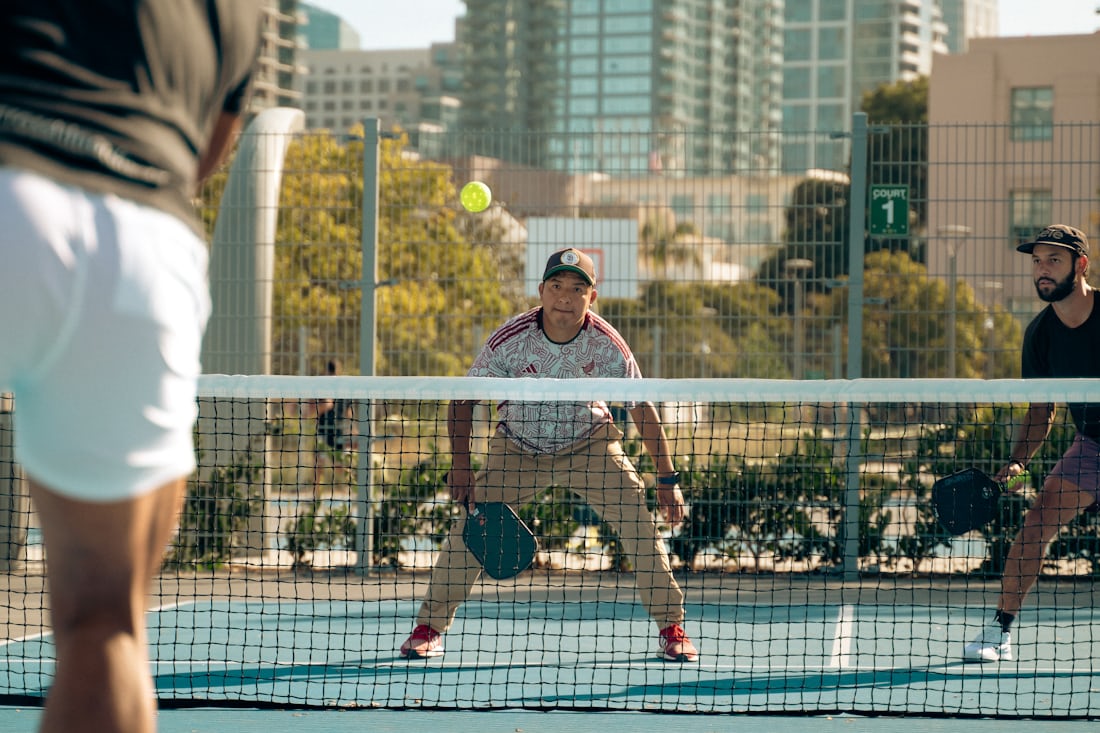
Walk onto a pickleball court during singles play after spending months in doubles rec games and the first few points feel like someone changed the rules without telling you. The court is the same size. The net is the same height. The scoring format is recognizably similar. And yet almost every instinct built in doubles is wrong or incomplete the moment there's no partner standing next to you.
That's because pickleball strategy, as most players learn it, is doubles strategy. Our strategy basics guide covers the eight fundamentals — stacking, poaching, calling the middle ball, targeting the weaker partner's backhand — that assume two players per side working as a coordinated unit. Nearly all of it depends on having a partner to cover half the court, communicate with, and hide a weakness behind. Take the partner away and you don't get a simpler version of doubles. You get a different game that happens to use the same court and paddle.
This piece is about that difference: why doubles dominates rec play, how court coverage and shot selection change when you're alone out there, why the third-shot drop — pickleball's most obsessed-over shot — matters less in singles, and what singles demands from your body that doubles doesn't.
Why doubles is the sport almost everyone plays
If you've only seen pickleball at a local park or club open-play session, you may not realize singles is a sanctioned, competitively played format at all. It is — USA Pickleball runs singles divisions at every level, and it's an event at major tournaments including the U.S. Open and PPA Tour stops. But at the rec level, singles is genuinely rare, and there are structural reasons beyond habit.
The most obvious reason is the court itself. Pickleball, unlike tennis, does not narrow the court for singles — the playing surface is 20 feet by 44 feet for both formats, with no doubles alleys to remove. A singles player covers the exact same amount of court that two doubles players split between them. In tennis, singles takes away width; in pickleball, singles adds a full second player's worth of ground for one person. That's a much bigger physical ask, and it's a big part of why singles skews toward fitter, more competitively minded players rather than being the default rec format.
Social structure matters too. Open-play sessions are built around rotating groups, and doubles lets four people play together and keeps the court moving for a crowd. Singles is a two-person, one-court commitment — harder to organize when six or eight players show up, and less social by design. Add in that singles is more physically demanding and has a steeper shot-selection learning curve (more below), and it's easy to see why most rec pickleball — and most strategy content, including our own strategy basics guide — is written for doubles.
None of that makes singles a lesser format — competitive players often call it the better test of shot-making and conditioning, precisely because there's nowhere to hide. But if your game is built entirely on doubles patterns, the switch requires rethinking the point from scratch, not just covering more ground.
Court coverage: from split responsibility to total responsibility
In doubles, two players share the court and, once both teams are at the kitchen line, mostly stay in a fixed lane — left player covers the left half, right player covers the right half, with a shared responsibility zone down the middle resolved by communication ("mine," "yours"). A doubles player's footwork is lateral and short: slide left, slide right, stay on the line. Deep balls, lobs, and anything behind you are a shared problem, often solved by one partner covering while the other resets.
In singles, there is no shared responsibility zone, because there's no one to share it with. You are the entire defense for 20 feet of width and 22 feet of depth on your side of the net. A ball hit crosscourt to the opposite corner is entirely your problem, every time. This changes footwork fundamentally: singles players cover far more ground per point, moving not just laterally along the kitchen line but constantly in and out — forward to attack a short ball, backward to cover a lob. The transition zone doubles strategy tells you to sprint through as fast as possible becomes, in singles, a place you'll spend real time in, because you can't always reach the kitchen line before the next shot arrives — no partner is already up there holding position while you catch up.
The practical effect: singles rewards court sense and anticipation more than doubles does. A doubles team can win largely on positioning discipline — get to the line, stay there, dink patiently. In singles, positioning discipline alone doesn't cover a court built for two people, so movement efficiency and reading an opponent's paddle angle matter more. Singles players tend to recover to a central "home" position after each shot — not the kitchen line specifically, but whatever gives the best angle to cover the next likely shot — rather than committing to a fixed spot the way a doubles team does.
Serve and return: no partner, no second server, different targets
Doubles serving strategy is built around exploiting a mismatch: serve deep to the weaker player's backhand, force a difficult return, and use the extra split second to get your team moving toward the kitchen. Doubles also has the "second server" structure at the start of each game (only one partner serves on the first service turn) and the rule that both partners get to serve, one after the other, before the serve passes to the other team.
Singles strips that structure down. There's only one player per side, so there's no second-server exception and no serve-count call in the score — just your score, your opponent's score, instead of the three-number call (server score, receiver score, server number) doubles uses. The serving side is determined purely by your own score: serve from the right court when your score is even, the left court when it's odd. That's a genuinely different mental habit if you've only played doubles, where server-number tracking is a bigger deal and the serving side depends on team positioning rather than a simple even/odd rule.
Tactically, singles serving and returning shift targets too. In doubles you're serving at a known weakness — the backhand of whichever partner is weaker. In singles you're serving at one opponent's entire game, and because there's no partner to cover for them, a deep serve that pulls them wide or jams them in the body creates a bigger problem: they have to cover the return of their own next shot with no help. Depth matters even more in singles serving, since a shallow serve gives time to set up an aggressive return with nobody to punish the resulting gap. Singles returns are also more often hit with pace and depth rather than doubles' softer, more conservative returns — with no partner at the net yet to protect, a hard, deep return immediately puts a singles opponent on the back foot.
Why the third-shot drop matters less in singles
If you've read our breakdown of the third-shot drop, you know why it's considered the most important shot in doubles: the serving team is stuck at the baseline while the returning team is already dug in at the kitchen line, paddles up, ready to punish anything driven at net height. The drop exists to solve that structural trap — a rescue shot for a bad geometric position created by two players standing shoulder to shoulder at the net.
That trap is far less severe in singles: there's only one opponent at the net, not two. A driven third shot in doubles has to get past two paddles covering the width of the court together, with almost no gap to aim at. A driven third shot in singles only has to get past one player, who can't be in two places — there's a real gap on either side that doesn't exist when a doubles team stands together. Singles players can often hit a firmer, more aggressive third shot — a drive to the open side, or at the body — and reasonably expect to win the point outright, rather than being forced into the low-margin, high-touch drop doubles strategy treats as near mandatory.
This doesn't mean the drop disappears from singles. A soft, well-placed drop is still useful, especially against an opponent already at the net with good hands, and it's the safer play when a hard third shot would be low-percentage. But singles players use it as one option among several rather than the default, near-automatic response drilled into every doubles player. With more open court and only one player to beat, singles rewards shot variety on the third ball — drives, drops, and lobs all stay in the toolkit — where doubles narrows hard toward "drop it or don't try" because the penalty for a bad drive is so severe against two players at the net.
The flip side: singles dinking exchanges, when they happen, resolve differently too. With only one opponent to move around, a patient dinker can often open a passing lane or lob opportunity that simply doesn't exist in doubles, where a partner is always there to cover the space you just tried to exploit.
Stamina and conditioning: the demand that dwarfs everything else
Ask any competitive player who's tried both formats what the single biggest difference is, and conditioning tops the list more often than any tactical answer. A doubles point distributes the running across two players, and rec-level doubles rallies are frequently settled by a single unforced error rather than either team running the other down. A singles point puts the entire physical burden — sprinting corner to corner, recovering after every shot, covering lobs a partner would otherwise track down — on one player for the full rally, and singles rallies at a competitive level often run longer precisely because there's more open court for a fit, well-positioned player to keep the ball in play.
Over a full match, that adds up to a categorically different physical output. Singles is closer in cardiovascular demand to competitive tennis or badminton singles than to rec doubles pickleball, which — at the open-play pace most beginners experience — is a comparatively low-intensity, short-burst activity. Players moving from doubles to serious singles play consistently report needing to build baseline aerobic fitness and sprint-recovery capacity they never needed for doubles, where good positioning sense can substitute for elite conditioning. Doubles-focused drilling — dinking cross-court, third-shot-drop reps, stacking walkthroughs — doesn't prepare your legs and lungs for a real singles match.
That's worth knowing before signing up for a singles bracket expecting your doubles game to translate directly. The strategic instincts you'll need to unlearn are real, but the conditioning gap is often the bigger surprise.
The short version
Doubles and singles pickleball are the same sport by rulebook and nearly different sports by feel. Doubles rewards positional discipline, partner communication, and the third-shot drop as a near-automatic response to two opponents dug in at the net. Singles rewards court coverage, serve depth, shot variety on the third ball, and — more than anything tactical — raw conditioning, since there's no partner to share the running or decision-making. If your game is built entirely on doubles fundamentals, don't assume it transfers; the geometry of the point has changed, even though the court hasn't.
Find a court and try both formats
Most open-play sessions default to doubles because that's what fills a court with four rotating players, but plenty of venues also run singles ladders, challenge courts, or off-peak hours where singles is easy to set up with just one other player. The Court Scout maintains a verified directory of pickleball courts across the US with hours, surface type, and drop-in details — a good place to find a quieter slot to put the strategy above to work.
Sources
This guide draws on USA Pickleball's official rules and scoring resources (court dimensions, singles serving and scoring rules) and general strategy commentary on the differences between singles and doubles play. Facts on rules and dimensions are drawn directly from official documentation; tactical and conditioning observations reflect what is consistently reported across competitive pickleball coaching and commentary.