Knowing the fault list and actually avoiding faults are two different skills
Our pickleball rules guide lists every fault in the current rulebook — out of bounds, serve faults, non-volley-zone violations, the two-bounce rule, net touches, carries. That's the reference version: accurate, complete, and mostly useless mid-rally, because faults rarely happen from not knowing the rule. They happen because a body under time pressure does something the rulebook doesn't allow, usually without the player noticing until someone calls it.
This guide covers that gap: for each fault that comes up constantly in real games, the mechanism — what's physically happening when a player commits it, why it keeps happening even to people who know better — and the habit that fixes it. We're also covering something the rules guide doesn't: how faults actually get called on a real court, since "who's watching" changes enormously between a rec session and a sanctioned tournament.
Kitchen foot faults: the most common fault in the sport, and why
If you watch any beginner-heavy rec session for twenty minutes, you'll see this fault more than every other fault combined: a player volleys the ball, and either during the swing or immediately after, a foot is touching the kitchen (the non-volley zone) or its line.
Why it happens. It's almost never a rules-knowledge problem — most beginners who get called for it can immediately tell you why it was a fault. It happens anyway because of two physical habits the rule doesn't forgive:
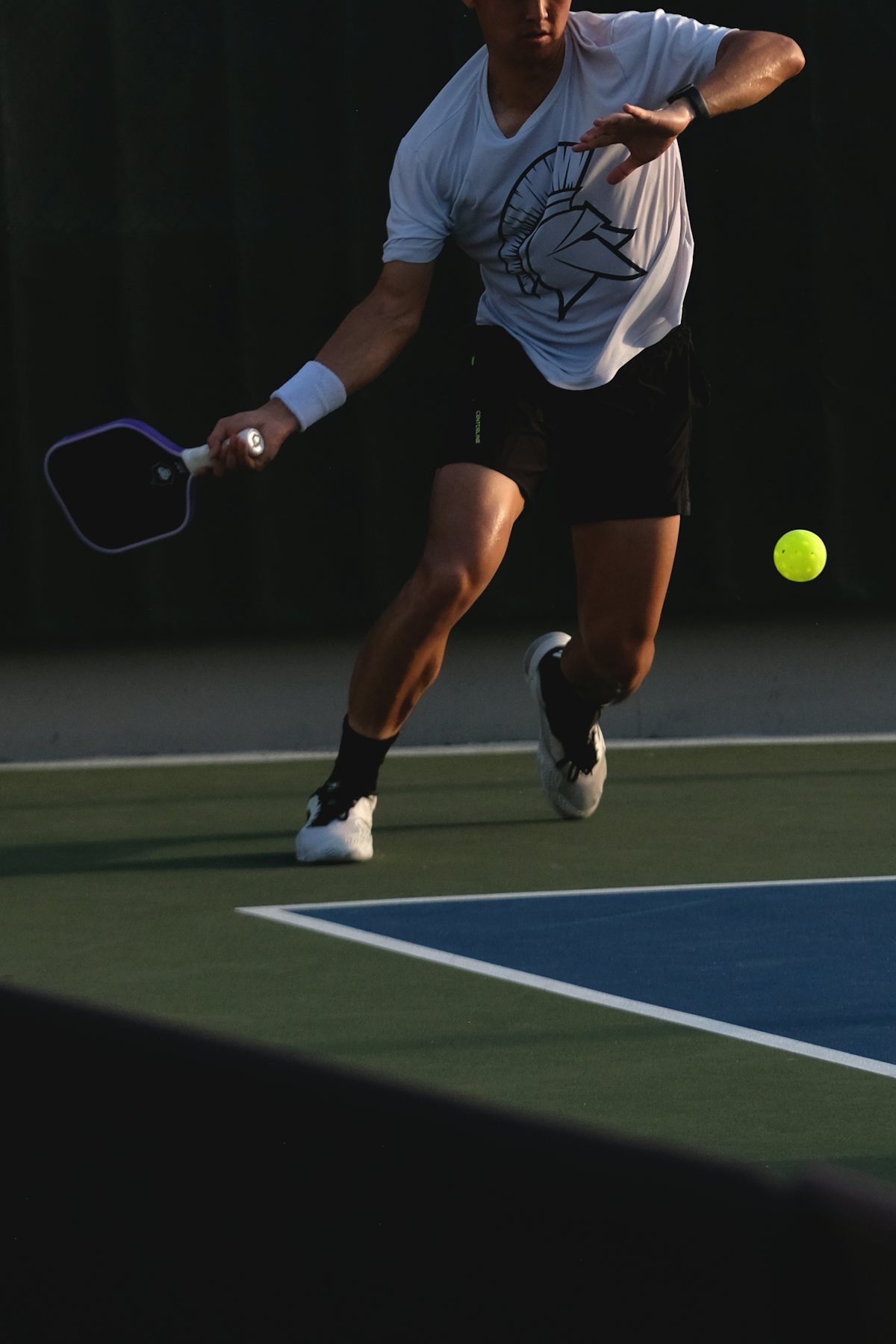
- The push-off foot fault. A player standing just behind the kitchen line lunges forward to reach a ball, and the back foot — the one doing the pushing, not the one reaching — clips the line or the zone on the push-off. Players fixate on where their reaching foot lands and never track the trailing foot, because in almost every other sport (tennis, basketball, volleyball) nobody cares what your back foot does during a lunge. In pickleball, both feet are live the whole time.
- Momentum carrying you in after contact. This one generates the most arguments, because the shot itself can be a clean, well-struck winner. A player volleys legally from outside the kitchen, but the follow-through or the body's forward momentum carries a foot (or the paddle) into the zone a half-second later. The rule doesn't care that the ball was already gone — contact and the motion connected to that same shot both count. A hard, committed volley naturally carries your weight forward, so the fault is a direct physical consequence of swinging with real pace from close to the line.
A third, less common but real version: re-establishment. You can walk into the kitchen any time the ball isn't being volleyed — to retrieve a ball, or dink one that's already bounced. But before your next volley, both feet must be fully back outside the zone, not just moving that direction. Players who dink from just inside the line and step back to volley the next ball often don't get their trailing foot fully clear first.
How to avoid it.
- Track your back foot on every lunge, not just your reaching foot — a training-attention fix, since most players have simply never been told to think about the foot that isn't doing the visible work.
- After any aggressive volley near the line, freeze for a beat before moving your feet again, rather than letting momentum carry you wherever it wants — the single most effective habit against the momentum-carry version of this fault.
- Play a hair further back from the line than feels necessary at first. New players crowd the line because it feels aggressive and correct. A few extra inches of buffer costs almost nothing in reach and removes the margin-of-error problem behind most push-off and momentum faults.
Serve faults: where the one-shot rule punishes small mechanical drift
Pickleball gives you exactly one serve attempt — no second serve, unlike tennis — so a serve fault costs the full point (a side out or a lost point, depending on scoring format) with zero chance to recover. That stakes-raising is exactly why serve faults are so common: players who are otherwise consistent hitters get tight specifically because there's no do-over, and tight mechanics drift toward illegal ones.
Three ways this shows up in real play:
- Contact creeping above the waist, or the paddle head creeping above the wrist. Both degrade the same way: a player trying to add pace tosses the ball a little higher and swings a little harder, pulling the contact point up. USA Pickleball requires both standards be met "clearly," giving referees latitude to call borderline serves as faults rather than defaulting to the server's benefit of the doubt.
- A serve that clips the kitchen instead of clearing it. Depth-chasing is the usual cause: a serve aimed for depth that comes up even slightly short lands in the kitchen — a fault, no partial credit for how close it was.
- An inconsistent toss or drop. Because the serve only gets one live attempt, a release point that varies from serve to serve forces your timing to re-solve itself every time — exactly the variability that produces both faults above and simple mis-hits into the net or wide.
How to avoid it. Build a repeatable, low-margin toss and a shoulder-driven (not wristy) swing before you add pace or spin — covered in depth, with a full practice progression, in our how to serve in pickleball guide. In the moment, if you're missing serves at a tournament or a tight rec game, take pace off and re-groove depth and legality first — a moderate serve that's actually live beats an aggressive one that's live only half the time.
Out-of-bounds and net faults: the ones players don't think are "real" faults
Two faults get treated less seriously than they should be, mostly because they feel like ordinary misses rather than rule violations:
- Hitting the ball out of bounds — long, wide, or into the net — is the most obvious fault in the sport, but worth naming the real-play cause: most out-of-bounds errors in rec play come from overhitting a ball that didn't need pace, usually a return of serve or a mid-court ball a player treats like a put-away when the smarter shot was a controlled drop or reset. The fix is less about mechanics and more about shot selection.
- Touching the net or net post during a live point is a fault players routinely don't realize they've committed — it can be a light brush of the paddle, clothing, or hair on a hard follow-through, not a dramatic collision. It's most common on hard volleys or overheads hit close to the net, where an aggressive swing naturally carries the paddle forward and down toward net height. The fix: shorten your follow-through slightly on any volley hit from near the net.
Both get missed constantly in rec play precisely because they don't look like "real" faults the way a serve into the net does — nobody's tracking a stray paddle brush against the net the way they're tracking whether a serve landed in.
The two-bounce rule violation: the fault that shows up almost only in beginners' first few games
The two-bounce rule — the ball must bounce once on the return of serve and once more on the return of that return before either side can volley — is the rule most specific to pickleball, and the violation is almost entirely a beginner phenomenon. Players coming from tennis, racquetball, or badminton have spent years training the instinct to crash the net and put away anything reachable out of the air; pickleball asks them to actively suppress that instinct for the first two shots of every point.
Why it happens. It's rarely a knowledge gap — most players who commit this fault can recite the rule correctly if you ask them cold. The instinct to volley a hittable ball is simply faster than the conscious check of "has this bounced on both sides yet." A ball that comes back soft and high off the serve return looks exactly like a put-away to a net-sport instinct, and the fault happens before "wait, has the second bounce happened" has time to register.
How to avoid it. This one mostly resolves with reps — the mandatory-bounce sequence becomes automatic the same way any repeated pattern does. Until then, the fix is positional: stay back near the baseline through your team's return of serve and your opponent's return of the return, and don't move forward to the kitchen line until both mandatory bounces have happened. Standing back removes the temptation entirely — a ball you can't comfortably reach isn't a ball you're tempted to volley. Once both bounces are done, you're free to move in and start playing net-forward pickleball, covered in our pickleball strategy basics guide.
How faults are actually called: rec play vs. tournament play
This surprises a lot of newer players, because it changes who's responsible for catching every fault above — worth knowing before you show up to either setting expecting the other one's rules.
At most rec courts, pickleball is entirely self-officiated. There's no referee at your neighborhood park or Tuesday-night club session — players make every call themselves, on the honor system. Under USA Pickleball's own rules for self-officiated play, only the players on the side the ball lands on make line calls on that ball, and if partners on the same side disagree with each other, the ball is ruled in. Kitchen and service foot faults work a little differently: a player is expected to call those against themselves when noticed, but opponents may also call one against the other side, as long as it's called immediately, not retroactively. If the two sides disagree, the standard resolution is a replay rather than an argument.
Practically, rec-court fault-calling runs on trust and self-reporting. Most players call their own obvious faults (a foot that clearly touched the kitchen, a serve they know clipped into the zone) unprompted, because that's the culture that keeps rec pickleball fun rather than adversarial. Borderline calls get resolved by conversation and good faith, not an outside authority — call obvious faults on yourself before your opponent has to, and don't contest a close call aggressively; a friendly "let's replay it" resolves almost everything at the rec level.
Tournament and higher-level play introduces certified referees, most consistently for medal matches, professional events, and the higher divisions of sanctioned tournaments — USA Pickleball runs its own referee certification program for this. A certified referee makes the calls a self-officiated match leaves to the players — line calls, service faults, kitchen violations, let-serve rulings, score-keeping — with a clear appeals process if disputed. Lower divisions of the same tournament, especially amateur and recreational skill levels, are frequently still self-officiated even at an otherwise-sanctioned event — check your tournament's format ahead of time rather than assuming a referee will be present.
The upshot: the standard you're held to changes with the setting. At a rec court, you're partly responsible for calling your own faults honestly; at a refereed event, that responsibility shifts to a neutral official, and you accept the call and move on rather than debate it the way you might with a training partner.
Where to go next
Fault-avoidance mostly turns into muscle memory with reps — the habits above (tracking your back foot, decelerating after aggressive volleys, staying back through the mandatory bounces) are worth consciously practicing for a few sessions until they stop needing conscious thought. For the full rulebook these faults are drawn from, see our pickleball rules guide. If your serve specifically is the source of most of your faults, our how to serve in pickleball guide covers the mechanics and a practice progression in depth. Once faults are under control, the next skill that actually wins points is what you do between the mandatory bounces and the kitchen line — our pickleball strategy basics guide picks up from there.
Sources
This guide is written and fact-checked against the current official rules and referee guidance published by USA Pickleball, the sport's national governing body, plus practical coaching material from an established pickleball outlet:
- USA Pickleball — Official Rulebook (current edition, PDF)
- USA Pickleball — Referees & Officiating
- USA Pickleball — Rules Summary
- The Dink Pickleball — The Push-Off Foot Fault Rule Everyone Gets Wrong
- The Dink Pickleball — What Is a Fault in Pickleball? Every Type Explained
Ready to put this on real courts? The Court Scout maintains a verified directory of pickleball courts across the US — every venue confirmed against a primary source, with real Google ratings, real hours, and honest cost info. Find courts near you and get some reps in.