The question every new player asks eventually
You've played a few open-play sessions. Maybe you've read a strategy guide or watched a coaching video. You're keeping rallies alive now, but you've also noticed you're stuck — the same mistake keeps showing up, or you feel like you're guessing at the fundamentals rather than executing them. At some point almost every improving player asks the same question: should I sign up for a group clinic, or should I book a private lesson?
The honest answer is that they're not competing options solving the same problem. A group clinic and a private lesson teach different things, to different audiences, in different ways — and the "right" one depends less on some universal ranking and more on what specific problem you're trying to solve right now. This guide breaks down what each format actually delivers, how to figure out which one matches your current stage, and how to think about the value trade-off without needing exact price numbers (those vary too much by region and provider to be useful here — call your local pro shop or club for real pricing).
What group lessons and clinics actually offer
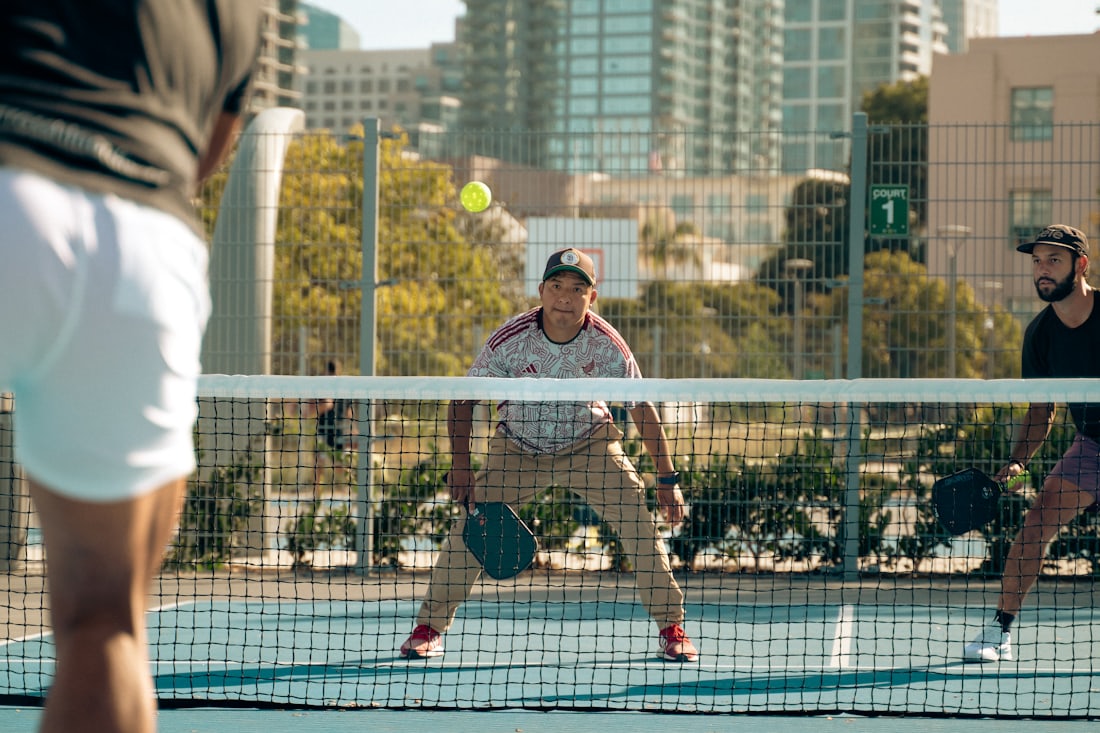
A group clinic typically means one certified instructor (or two, for larger groups) working with anywhere from four to twelve players at once, usually organized loosely by self-reported skill level (a "beginner clinic," a "3.0 clinic," and so on). The session is structured around a lesson plan — a specific rule, shot, or concept the instructor wants the whole group to walk away understanding — delivered through a mix of brief demonstration, paired drilling, and rotating live play.
What you actually get in a group setting:
- Structured instruction on the fundamentals. Court dimensions, the two-bounce rule, the non-volley zone, legal serves, basic scoring — genuinely confusing the first few times, with someone there to answer "wait, what?" in real time. This is the kind of content our pickleball rules guide covers on paper; a clinic covers it with a paddle in your hand and immediate feedback.
- Repetition against varied partners. In a group of eight, you'll rotate through several partners and opponents in one session, exposing you to different paces and skill levels faster than playing with the same friend every week.
- A social, low-pressure environment. Nobody in a beginner clinic is watching you critically — everyone's there because they're also new. That lowers the stakes considerably compared to walking onto an open-play court cold, where you might be the only person who doesn't know the local rotation norms (our pickleball etiquette guide covers those norms).
- Built-in community. Clinics are often how people find their first regular playing group. You show up alone; you leave with three or four names and a standing weekly game.
- Lower cost per hour of instruction. Because the instructor's time is split across the whole group, clinics are consistently the cheaper way to get formal coaching, hour for hour. Exact rates vary by club and region, but the pattern holds everywhere: splitting one instructor's attention eight ways costs each player a fraction of one-on-one attention.
What a group setting structurally can't do well: individualized correction. In a group of eight, the instructor might watch your specific swing for thirty seconds out of a ninety-minute session. If your problem is a subtle mechanical flaw — a grip rotating at contact, a backswing that's too long — a clinic can flag it in passing but can't drill it out of you. That's not a knock on clinics; it's just not the tool for that job.
What private lessons actually offer
A private lesson is one instructor, one player (sometimes two, for a semi-private with a regular partner), for a session built entirely around your specific goals. The instructor watches every single rep you hit, which changes what's possible in a way that scales down, not just up.
What you actually get in a private setting:
- Real-time, rep-by-rep correction. If your third-shot drop keeps popping up, a private instructor can watch ten drops in a row, isolate exactly what's failing (paddle face too closed, contact point too far forward, not enough knee bend), and have you feel the difference within the same session. The feedback loop is immediate and specific to your body and swing, not a generic cue given to a room.
- A lesson plan built around your actual weakness. You're not covering whatever topic the clinic schedule says is next — you're spending the whole hour on the one thing holding your game back, whether that's a stroke flaw, a strategic habit (see our strategy basics guide for the patterns a coach often corrects live), or match-specific problem-solving like handling a lefty opponent or heavy topspin.
- Faster technical correction. With constant feedback, private lessons tend to fix a specific, isolated problem faster than open play or group drilling — where you might see the flawed shot only a handful of times per session with no feedback on most of those reps.
- Video and data, at some facilities. Some coaches use slow-motion video review to show exactly what your paddle face is doing at contact — hard to deliver meaningfully to a group of eight at once.
- Pacing built around you, not a group average. A clinic has to move at a pace that works for the median player in the room. A private lesson moves at whatever pace actually helps you.
What a private lesson structurally can't do: replicate the chaos and social pressure of real doubles play with three other independent decision-makers on the court. One-on-one drilling with a coach who's feeding you predictable, well-placed balls is a controlled environment — valuable for fixing mechanics, but not a substitute for the read-and-react demands of an actual game against opponents who aren't trying to help you succeed.
How to know which one you actually need right now
The honest framework is less "which is better" and more "what problem am I solving at this exact stage":
- You're brand new — you don't know the rules, you've never held a paddle, you don't know what a "dink" or "the kitchen" means. Start with a beginner group clinic. You need the fundamentals explained once, clearly, with a paddle in your hand — not individualized correction on a swing you haven't developed yet. A clinic is also the fastest way to get comfortable with the social side of the sport before your first open-play session.
- You can rally and understand the basic rules, but your games feel chaotic and you don't know why you're losing. A strategy-focused group clinic is still a good fit — the concepts in our strategy basics guide are exactly the material a group format teaches well, since strategy is patterns everyone in the room needs to learn the same way.
- You have one specific, recurring problem you can name. "My serve gets called out constantly." "I can't stop popping up my dinks." "I lose every backhand exchange." This is the clearest signal a private lesson is worth the cost — a named, isolated problem is exactly what one-on-one correction fixes fastest. A clinic will touch on the general topic; a private lesson fixes your specific version of it.
- You've plateaued and can't self-diagnose why. A private lesson is usually the better first move here too — a coach watching you live can often spot the actual issue (frequently not what you assumed) faster than a group format, where nobody's watching closely enough to catch it.
- You want to drill a technique you already learned correctly, just build reps. Neither format alone — this is where structured solo and paired practice matters more than paid instruction. Our beginner drills guide walks through seven drills you can run without a coach present.
The cost/value trade-off, without invented numbers
We're not going to give you dollar figures here — rates vary enormously by region, club, and instructor credentials, and any number we printed would be stale or wrong for your market. But the qualitative trade-off is consistent everywhere:
Group clinics deliver a lower cost per hour of instruction, but a lower dose of individual attention per player. You're paying for structure, repetition, and social exposure, spread across a room. That's a genuinely good value proposition for anything that benefits from being taught the same way to everyone — rules, basic mechanics, common strategic patterns.
Private lessons deliver a higher cost per hour, but a much higher concentration of attention on your specific swing and your specific problems. That's a good value proposition when the thing holding you back is specific enough that generic instruction won't reach it, or when you're trying to compress months of trial-and-error into a few focused sessions.
The way to think about it isn't "which is the better deal" in the abstract — it's "am I trying to learn something that's the same for everyone, or fix something that's specific to me." The first is a clinic problem. The second is a private-lesson problem.
Most players benefit from both, at different stages
If you talk to instructors who teach both formats, almost none of them will tell you to pick one and stick with it forever. The realistic path most improving players follow looks something like: a beginner group clinic to learn the rules and get comfortable, several months of open play and self-directed drilling, a private lesson or two once a specific, nameable problem shows up, back to group play (now often a strategy-focused clinic) to build the fix into live-game habits, and then another round of private lessons the next time a new specific issue surfaces at a higher level. Group and private aren't rungs on the same ladder you climb once — they're two different tools you keep returning to as your game evolves and your problems get more specific.
If you're deciding what to book next, ask yourself the one-sentence version of the framework above: can I name a specific, isolated thing that's wrong with my game right now? If yes, book a private lesson. If you're not sure, or if what you need is exposure to the rules, the social scene, or general strategic patterns, a group clinic is the better next step — and almost certainly the cheaper one too.
Find somewhere to take that lesson
Most clinics and private lessons happen at dedicated pickleball clubs and larger public facilities that run structured programming — not every court has instructors on staff. The Court Scout maintains a verified directory of pickleball courts across the US, and many listings note whether a venue offers lessons, clinics, or coaching staff. Find courts near you to see what's available locally before you book.
Sources
This guide draws on USA Pickleball's official coaching and certification resources (which distinguish between group-clinic and private-lesson instructor certifications), publicly available program structures posted by certified pickleball instructors and coaching academies, and the same long-form instructional coaching (Sarah Ansboury, Briones Pickleball) already cited across our other strategy and technique guides, applied here to how instruction itself is typically delivered rather than to a specific shot or rule.