Why the smash means something different in a walled sport
Every racquet sport with a net has some version of an overhead — tennis has the serve and the overhead smash, badminton has the clear-turned-smash. Padel's smash looks similar from the stands: a player leaps under a lob and hammers it down into the opponent's court. But the shot means something structurally different in padel, and it comes down to one fact covered in our padel rules guide: the court is enclosed, and a ball that bounces once in play stays alive off the glass and mesh behind it.
In tennis, an overhead that lands in is often just over — the ball clears the baseline and the point is dead on contact, good or bad. In padel, a smash that clears your opponents entirely and sails long doesn't end the point. It bounces, hits the back glass, and comes off that wall at a playable height and pace for whichever opponent gets there first. A smash hit with more speed than placement can turn into a gift: you've done the hard work of generating pace, and now your opponent gets to redirect it with the wall doing half their work for them.
That single fact reshapes smash strategy in padel more than any other. The smash isn't automatically the highest-value shot just because it's the most aggressive one, and knowing when to hit a real smash versus a controlled overhead is arguably a bigger skill gap between intermediate and advanced players than raw power. This guide covers the mechanics of the smash itself, the two most important controlled alternatives — the bandeja and the víbora — and how to choose between them mid-point.
Basic smash mechanics
The padel smash starts well before contact, with positioning and preparation that most beginners rush.
Court position. Set up close to the net — roughly two meters back, not the four or five meters a defensive lob might pull you to. If a lob is deep enough or angled wide enough that you'd have to retreat a long way to reach it overhead, that's usually your first signal to hit a bandeja instead of a full smash (more on that below). The smash lives in the space near the net, where you have the width and depth of the court in front of you to work with.
Footwork. As soon as you read the lob, turn your body sideways — non-hitting shoulder pointing toward where the ball will land — and move back with quick, controlled steps rather than a flat-footed backpedal. You want your feet set and your base stable by the time you strike, not still adjusting mid-swing. Your non-dominant arm plays a real role here: raise it early, point it at the ball, and keep it up through your preparation. It's not decorative — dropping that arm early collapses your shoulder turn and flattens the swing, robbing you of the rotational power the shot depends on.
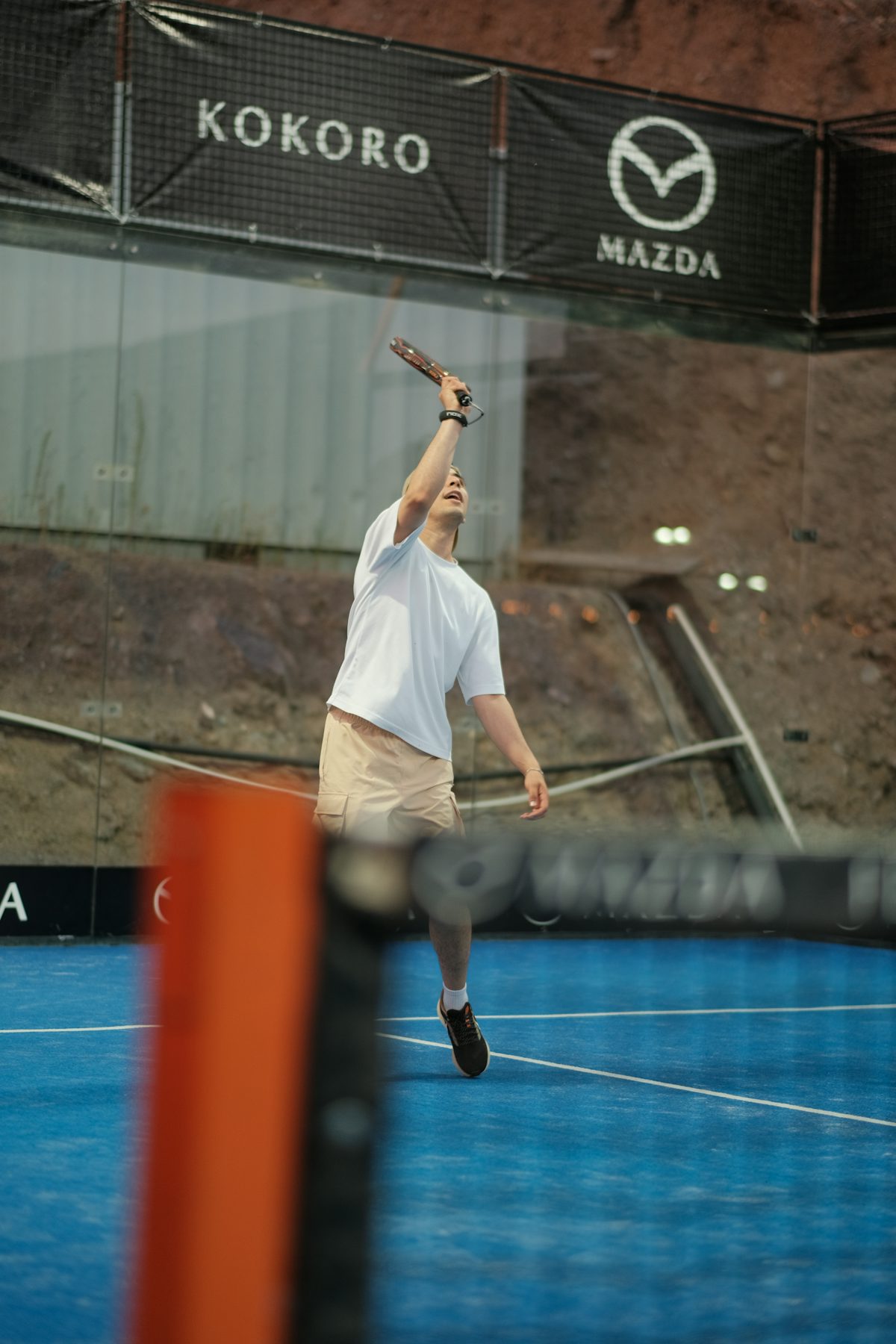
Contact point. Strike the ball above your head and slightly in front of your body, with a continental (handshake) grip. Contact happens with the racket face near the top of its arc — not while the ball is still rising, and not so late that it's dropped past your highest reachable point. Hitting it in front, rather than directly overhead or behind you, lets you drive the racket up and through the ball instead of just down on top of it.
Follow-through. A flat, hard smash follows through down and across the body, similar to a tennis overhead. But many of the most effective smashes in padel — often called kick smashes — use a slightly different path: the racket brushes up the back of the ball at contact, imparting topspin rather than relying purely on flat pace. That topspin is what makes the ball kick up hard and unpredictably off the back glass, rather than sitting up nicely for your opponent to counter. In practical terms: a smash with heavy topspin and moderate pace that kicks awkwardly off the wall is often more effective than a flatter, harder smash that bounces predictably.
The mental model. Treat the smash as a spin-first shot, not a pure power shot. Beginners tend to swing as hard as possible and treat any extra spin as a bonus; better players treat the brushing, up-and-through contact as the point of the shot, with raw speed as a secondary benefit.
The bandeja: the controlled overhead that keeps your net position
The bandeja — Spanish for "tray," describing how the racket face sits flat like something balanced on a serving tray during the stroke — is padel's most distinctive shot, and it exists precisely because of the wall problem described above. It's an overhead played with a short, controlled swing and a slicing, underspin action, hit with far less pace than a smash and aimed deep into the opponents' court rather than at a winner.
The point of the bandeja is not to end the rally. It's to neutralize a lob — usually one that's deep enough, or that you're not perfectly positioned under, that a full-power smash would be low-percentage — while staying at the net instead of retreating. You slice underneath the ball with backspin, which keeps the bounce low off the far wall and denies your opponents an easy attacking ball back, and the shortened, controlled swing means you recover into position quickly rather than being pulled out of the point by a big commitment shot.
This isn't a minor or occasional shot. In professional padel, the bandeja accounts for more than half of all overheads played — over two-thirds in the women's game — which tells you how often a "safe" overhead is actually the correct decision rather than a fallback for players who can't smash.
The víbora: an aggressive variation with sidespin
The víbora — Spanish for "viper" — shares its setup and preparation almost entirely with the bandeja: same footwork, same overhead position, same general timing. What changes is the contact. Instead of brushing underneath the ball for backspin and depth, the víbora sweeps across the outside of the ball with a sharp wrist snap, generating heavy sidespin and a flatter, faster trajectory than a bandeja.
That sidespin is the whole point. Where a bandeja is hit for depth and safety, a víbora is hit to make the ball kick sideways off the glass after the bounce, angling away from whichever opponent it's aimed at. It's most effective against an opponent who's already wide or off-balance — the sideways kick off the wall extends the angle they'd already have to cover, often putting the ball out of reach even though it never left the enclosure.
Because it demands precise timing on the wrist snap and more disguise than a bandeja, the víbora is generally considered a shot to layer on top of a solid bandeja once that's reliable, not a first overhead to learn. But it's worth knowing what it is and why it looks different from a standard bandeja when you see it played against you — the racket path and sound at contact are noticeably different once you know to look for them.
When to smash for a winner vs. when to play it safe
This is the actual decision players have to make in real time, lob after lob, and it's where the wall context from the top of this guide matters most:
- Smash when you have a clean, high, central ball and your opponents are in a bad recovery position. If the lob is short, sits up high, and you're well-balanced under it with a clear angle into open court, that's the moment to commit to pace and finish the point. A hard, well-angled smash from a strong position is genuinely hard to defend even with a wall behind it.
- Play a bandeja when the lob is deep, you're stretched, or your opponents are still well-positioned. If reaching the ball forces you backward, off-balance, or into an awkward contact point, a full-power smash off that base is low-percentage — you're more likely to net it, frame it, or send it long into an easy wall rebound for your opponents. A controlled bandeja keeps the point alive on your terms and holds your net position instead.
- Consider a víbora when an opponent is already scrambling wide. If you can read that one opponent is out of position and the other isn't yet covering for them, the víbora's sideways kick off the glass can finish the point without needing a full-power smash.
- Remember that a missed smash off the wall becomes their shot, not a dead ball. Because of the wall rule, a smash that goes long isn't automatically the safety valve it would be in tennis. If your only options are "smash long" or "smash into the net," a smash you're not confident in often isn't actually the higher-percentage play — a bandeja that stays in, deep and low, usually is.
The short version: power is a tool for finishing points you're already winning, not a way to force a point you're currently losing. Good padel players smash noticeably less often than beginners assume, and the bandeja usage numbers above back that up at the professional level.
Common beginner mistakes
- Smashing every lob, regardless of position. The single most common beginner habit is treating every ball above shoulder height as a smash opportunity. Against a deep or well-placed lob, that's usually the lower-percentage choice — see the bandeja section above.
- Dropping the non-dominant arm too early. Losing that arm's position collapses the shoulder turn and flattens the swing, which is why so many beginner smashes come out weak and off-target even when the setup looked good.
- Hitting the smash directly overhead or too far behind the body. Contact needs to happen slightly in front of the body to let the racket drive up and through the ball. Contact taken too far back robs the shot of both power and topspin.
- Chasing pure pace over spin and placement. A flat, hard smash with no topspin tends to sit up nicely off the back glass for the returning opponent. A smash with real upward brush and topspin kicks awkwardly and is genuinely harder to defend, even at a similar overall speed.
- Backpedaling flat-footed instead of turning and crossing over. Beginners often try to retreat facing the net the whole way, which leaves the feet unset at contact. Turning sideways early and moving back with a crossover step gets you to a stable base in time.
- Never developing a bandeja. Players who only ever practice the smash have no answer for the deep, awkward, or off-balance lobs that make up a large share of real points — which is exactly why the bandeja is the more frequently used shot even among professionals.
Where to go from here
The smash, bandeja, and víbora are shot mechanics — the wall rules that make the smash's risk/reward calculation different from tennis in the first place are covered in full in our padel rules guide. If you're still building the fundamentals before any of this matters, our beginner padel guide covers gear, court basics, and finding a game. And when you're ready to put any of this into practice, The Court Scout maintains a verified directory of padel venues, rebuilt from each club's own primary sources rather than scraped listings.
Sources
- LTA Padel — Overheads, Bandeja and the Smash
- Pelotista — The Bandeja Shot in Padel Explained
- Padel39 — The Art of the Bandeja: When and Why to Use It
- SimplePadel — Padel Víbora: Technique and When to Use It
- SimplePadel — How to Kick Smash in Padel
- International Padel Federation (FIP) — Rules of Padel, revision effective 01.01.2026 (PDF)
- The Court Scout — padel rules guide
- The Court Scout — beginner padel guide
- The Court Scout — global padel hub